FlexGuard Official Website › Blog › Is FlexGuard Anti-Inflammatory?
Is FlexGuard Anti-Inflammatory? Turmeric at 50 mg and Quercetin at 8 mg
The seller does not call FlexGuard anti-inflammatory. It says the capsule supports joint comfort, mobility and everyday joint stress, and it is not a drug. Turmeric and quercetin are on the label at 50 mg and 8 mg, far below the 1,000 mg and 250 mg amounts their studies describe.
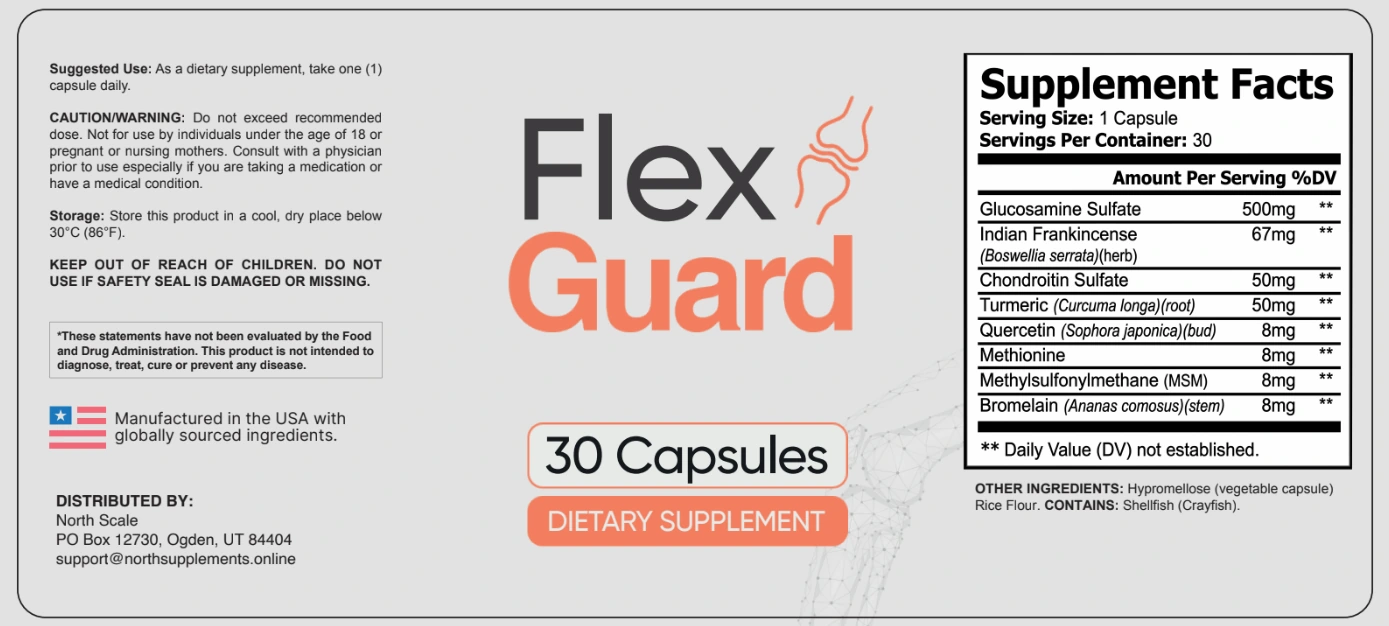
Many people search for an anti-inflammatory joint capsule. They often land on turmeric, quercetin or boswellia. Those names do appear on the FlexGuard panel, so the question is fair.
The answer needs care. A dietary supplement may not make drug claims. So this page does not say what FlexGuard does to inflammation. It says what the seller claims, what the label prints, and how those rows compare with their own research.
Does FlexGuard claim to be anti-inflammatory?
No. The seller names three things: it supports joint comfort, it supports mobility and everyday movement, and it supports the body through everyday joint stress. Those are structure and function statements, and they are the ceiling.
Nor is it a drug, and the FDA has not approved it. It does not diagnose, treat, cure or prevent any disease, and it does not treat, prevent or manage arthritis. A page that says it is an anti-inflammatory medicine is describing something this seller does not say.
Why do turmeric and quercetin appear in these searches?
Plant ingredients are studied for their effect on inflammatory signalling, not on cartilage structure. Boswellia, turmeric, bromelain and quercetin all sit in that group, and all four are on the FlexGuard panel.
That is why a person typing anti inflammatory joint supplement into a search box may reach a FlexGuard page. The match is about the ingredient family. It is not a claim about this capsule.
Two bottles last 60 days, the same as the guarantee window. The checkout shows the current price.
See today's price and guarantee
Disclosure: this desk earns from orders placed through the checkout on this site. BuyGoods, the retailer at the checkout, shows the current price.
What does the turmeric row really say?
The label prints Turmeric (Curcuma longa) (root) at 50 mg. The word root matters. Curcuminoids, the compounds behind most turmeric research, are a few per cent of the root by weight and the great majority of a standardised extract.
| Point | FlexGuard label | What the research describes |
|---|---|---|
| Form | Root, 50 mg | Standardised extract |
| Daily amount | 50 mg | Around 1,000 mg of curcuminoids in the 2016 meta-analysis |
| Largest trial named | Not applicable | 367 people on 1,500 mg a day of a standardised extract |
| Standardisation figure | Not published | Stated in the trials |
Sources named on the FlexGuard ingredients page.
NCCIH adds one more detail: curcumin is poorly absorbed on its own. Fifty milligrams of root is a different proposition from fifty milligrams of extract, and the label does not say which curcuminoid share it holds.
What is quercetin doing on the label at 8 mg?
Quercetin is a flavonoid found in onions, apples, capers and tea. For supplements it is taken from the flower bud of the Japanese pagoda tree, which is the part the label names.
A normal mixed diet supplies tens of milligrams a day. The German federal safety review describes supplement intakes from 250 mg up to 1,500 mg a day. Work on absorption shows how little of an oral dose reaches the blood.
Eight milligrams sits below what a plate of onions supplies. The seller does not say why the row is there. It reads as a name on a broad panel, not as a studied amount.
Is boswellia the better fit?
Of the plant rows, boswellia comes closest. The label prints Indian Frankincense (Boswellia serrata) (herb) at 67 mg. Studies used 100 to 250 mg a day of a 30 per cent AKBA extract, and a 2003 crossover trial used 333 mg three times a day.
The caution is the same one. The label gives no extract ratio and no AKBA percentage, so the comparison is only indicative. There is a full look at this row on the boswellia deep-dive.
What about the 367-person trial against ibuprofen?
A trial of 367 people used 1,500 mg a day of a standardised turmeric extract and reported results comparable to ibuprofen. It is the strongest single turmeric result this site names.
It does not describe FlexGuard. The capsule has 50 mg of root, not 1,500 mg of a standardised extract. Nobody should read that trial as a statement about this product, and no trial of this formula has been run.
What should you do if you want real relief from inflamed joints?
Joint pain that is new, severe, one-sided, hot, swollen, or that followed an injury needs to be examined, not supplemented. A single appointment settles more than a year of capsules.
If a doctor has already advised you on pain or medicines, do not change them because of a supplement page. Ask the doctor whether this capsule is suitable, and mention the shellfish line and any blood thinner you take.
- The seller does not call FlexGuard anti-inflammatory. It is sold as a supplement, not a drug.
- Label: Turmeric (Curcuma longa) (root) 50 mg. Quercetin (Sophora japonica) (bud) 8 mg.
- Turmeric research describes about 1,000 mg a day of curcuminoids. Quercetin supplement intakes run from 250 mg up.
- Boswellia at 67 mg is the plant row closest to its own research.
- No extract ratio, AKBA figure or curcuminoid percentage is printed.
- No trial of this formula has been run.
Frequently asked questions
Is FlexGuard an anti-inflammatory?
The seller does not make that claim. Its statements stop at joint comfort, mobility and everyday joint stress. The product is sold as a dietary supplement, and the FDA has not approved it.
How much turmeric is in FlexGuard?
The label prints 50 mg of turmeric root per capsule. The research this site names describes about 1,000 mg a day of curcuminoids from a standardised extract. The curcuminoid share of this row is not published.
How much quercetin is in FlexGuard?
Each capsule has 8 mg of quercetin from the bud of Sophora japonica. Supplement intakes in the German safety review run from 250 mg to 1,500 mg a day.
Does FlexGuard work like ibuprofen?
No. FlexGuard is not a drug and makes no such claim. The 367-person trial that compared a turmeric extract with ibuprofen used 1,500 mg a day, far more than this capsule holds.
Which plant row is closest to its research?
Boswellia at 67 mg. Studies used 100 to 250 mg a day of a standardised extract, though the label gives no extract ratio, so the match is only indicative.
Should I ask a doctor before taking it?
Yes. The label says to consult a physician if you take a medication or have a medical condition. Joint pain that is new, severe, hot or swollen needs examining first.
Our view
The anti-inflammatory idea is the reason turmeric, quercetin and boswellia are on this panel. It is not a promise the seller makes, and the amounts do not reach what the research describes for two of the three.
We would describe FlexGuard as a modest joint capsule with a plant section that is mostly small. That is a fair thing to buy if you want it, and a poor thing to buy for a specific effect. Your doctor is the right person for any question about inflammation.
Three bottles cover 90 days, and the guarantee counts from the day you pay.
See today's price and guarantee
Disclosure: this desk earns from orders placed through the checkout on this site. BuyGoods, the retailer at the checkout, shows the current price.
FlexGuard is a dietary supplement. It is not a drug, it is not FDA approved, and no dietary supplement is. These statements have not been evaluated by the Food and Drug Administration. This product is not intended to diagnose, treat, cure or prevent any disease. Ask a doctor about your own health, medicines and joints.
Sources named on this site
Last updated