FlexGuard Official Website › Choosing A Joint Supplement
Choosing A Joint SupplementChoosing A Joint Supplement: A Nine-Point Checklist
Nine questions that separate joint bottles faster than any front label.
Disclosure, dose adequacy, form, extract ratios, allergens, the claims a seller makes, the refund window, what else is in the capsule and how long a fair trial takes. The last section scores this website's own product against all nine, including the four points where it does badly.
A checklist is only worth publishing if the product beside it can fail some of it, so this one is scored in public.
The nine points, in the order they discard bottles
Nine questions, and the first one alone removes a large part of the shelf.
Does the panel print an amount for every row?
A proprietary blend with one total means nothing on that label can be compared with its own research. This is the fastest filter there is and it removes a large fraction of the category in about five seconds.
Does the largest row reach its researched amount?
On most joint capsules the largest row is glucosamine, and the amount to look for is 1,500 mg a day. The trials used that figure, and anything far below it is untested rather than tested and found wanting.
Are the plant rows standardised, and does it say so?
An extract with no ratio and no marker percentage cannot be matched to a trial. For boswellia, look for an AKBA figure; for turmeric, a curcuminoid percentage; for bromelain, an activity unit.
Is anything present in a unit smaller than its research used?
MSM in milligrams where the literature runs in grams is the clearest example. A row like that is on the label for the label.
How many capsules a day does it take?
Not a quality question but the strongest predictor of whether anybody finishes a two-month trial. A four-capsule regimen at a full dose that stops in week three is worth less than a one-capsule regimen that does not.
Does it declare its allergens plainly?
Glucosamine products almost always declare shellfish, and a label that names the species is doing more than the minimum. It also answers the vegan question, which a capsule material alone does not.
What does the seller claim it does?
A page using treats, cures, prevents or manages about a named condition is telling you something about itself. The FTC’s guidance sets out what a seller has to be able to substantiate.
How long is the refund window, and from when?
Sixty days is roughly the right length for a category whose trials ran eight to twelve weeks. Thirty days ends before anybody could form a view. Check whether it counts from purchase or from dispatch.
Is there anything in the capsule you did not want?
Fillers, sweeteners, colourings and the capsule material itself. Two inactives is a short list; eight is worth a second look, particularly on a product taken daily for months.
Three things this checklist deliberately leaves out
Three signals that look decisive and are not.
The number of ingredients
A longer list is usually worse rather than better. A capsule holds a fixed amount of powder, so every extra name is a smaller share of it. Eight ingredients in one capsule means small amounts of most of them, arithmetic that no marketing sentence changes.
Seals and badges
A GMP mark and a registered-facility roundel describe how a product was made rather than what is in it, and neither is a test result. Ask who says so and what they tested; if a seal answers neither, it is a graphic.
The star rating
A summary figure from the seller's own site tells you a proportion of buyers said something positive. It is not a clinical result and it does not say what they were comparing the product with.
Those three are the loudest things on most product pages in this category and the least informative. The milligram column is quiet, small and decisive, and it is the reason the first point on this checklist is the first point.
Scoring FlexGuard against all nine points
Six passes, three fails, and the three fails have one cause between them.
| # | The question | FlexGuard | Score |
|---|---|---|---|
| 1 | Amount for every row | Yes. Eight rows, eight numbers, 699 mg in total | Pass |
| 2 | Largest row at its researched amount | No. Glucosamine 500 mg against 1,500 mg in the trials | Fail |
| 3 | Plant rows standardised and stated | No. No AKBA figure for the boswellia, no curcuminoid percentage for the turmeric | Fail |
| 4 | Nothing in a unit smaller than its research | No. Four rows at 8 mg, and MSM's trials ran in grams | Fail |
| 5 | Capsules a day | One. The strongest thing on this label after point 1 | Pass |
| 6 | Allergens declared plainly | Yes. Contains: Shellfish (Crayfish), species named | Pass |
| 7 | Claims within the ceiling | Yes. Joint comfort, mobility and everyday joint stress, and nothing further | Pass |
| 8 | Refund window | 60 days, counted from the date of purchase | Pass |
| 9 | Nothing unwanted in the capsule | Two inactives: hypromellose and rice flour | Pass |
Six passes and three fails, and all three fails are the same fail: eight ingredients in one capsule means small amounts of most of them.
That is the honest scoreline. This product is strong on everything a label can control by being candid, and weak on everything a single 699 mg capsule cannot escape.
A buyer who cares most about points 1, 5, 6 and 8 will find this a good bottle. A buyer whose priority is point 2 should buy a dedicated glucosamine and chondroitin product at the trial amounts, swallow three or four capsules a day, and pay less for it. The pricing page puts the cost per day beside that alternative rather than pretending it does not exist.
Publishing a scoreline a website's own product fails three times is the whole point of a checklist. One that scored nine out of nine would be a sales page with numbers on it.
Whether any of it will help your joints. Nine points about a label say nothing about an outcome, and no capsule in this category has evidence of the size that the exercise literature has. Buy the supplement if you want it; do the other thing regardless.
Choosing a formula: short answers
What is the single most useful thing on a label?
The milligram column. A panel that prints an amount for every row is the only kind that can be compared with anything.
Is a longer ingredient list better?
Usually the opposite. A fixed capsule holds a fixed amount, so more names means smaller amounts of each.
Should I avoid anything with a proprietary blend?
It is the strongest single filter available. A blend total means no row can be checked against its own research.
How does FlexGuard score on this checklist?
Five of nine. It is strong on disclosure and format and weak on dose adequacy, and the scoring is set out in full at the foot of this page.
Who publishes this FlexGuard website?
- Clegg DO, Reda DJ, Harris CL, et al. Glucosamine, chondroitin sulfate, and the two in combination for painful knee osteoarthritis. N Engl J Med. 2006;354(8):795-808. PMID 16495392. https://pubmed.ncbi.nlm.nih.gov/16495392/
- Butawan M, Benjamin RL, Bloomer RJ. Methylsulfonylmethane: applications and safety of a novel dietary supplement. Nutrients. 2017;9(3). PMID 28300758. https://pubmed.ncbi.nlm.nih.gov/28300758/
- Federal Trade Commission. Health Products Compliance Guidance. December 2022. https://www.ftc.gov/business-guidance/resources/health-products-compliance-guidance
- Fransen M, McConnell S, Harmer AR, et al. Exercise for osteoarthritis of the knee. Cochrane Database Syst Rev. 2015;1(1):CD004376. PMID 25569281. https://pubmed.ncbi.nlm.nih.gov/25569281/
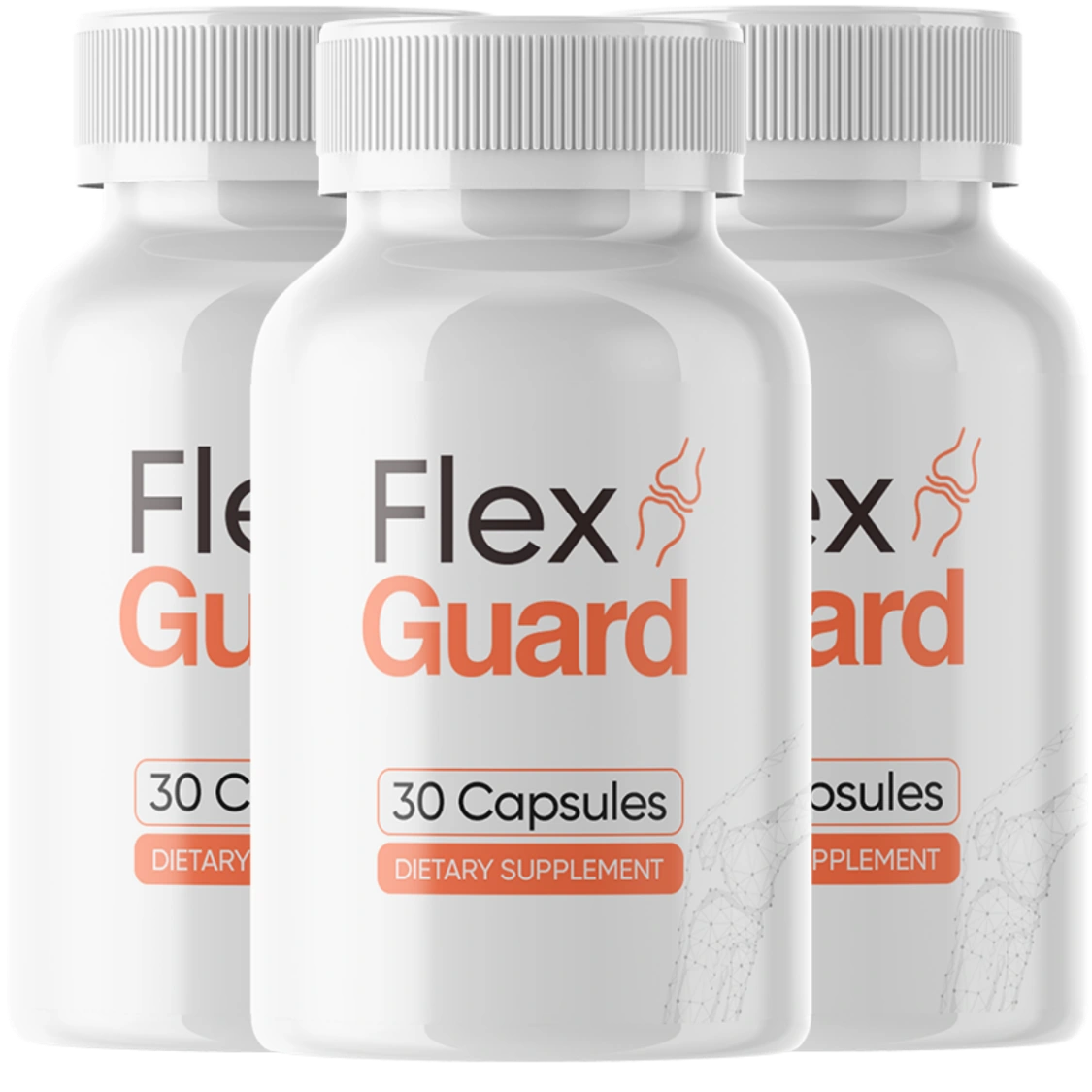
FlexGuard scores six of nine, and the scoring is on this page
Strong on disclosure and format, weak on dose adequacy. Sixty days from purchase to decide whether that trade suits you.
Two bottles $158 · six bottles $294 · 60 days from purchase
Order FlexGuard On The Official WebsiteOne capsule a day · 30 per bottle · lot FLE-26/FL-2166