FlexGuard Official Website › Supplement Facts
Supplement FactsFlexGuard Supplement Facts: The Whole Panel, Line For Line
One capsule, thirty to a bottle, eight actives with an amount against each.
Glucosamine sulfate 500 mg leads and the eight together come to 699 mg. Beneath them the label prints hypromellose and rice flour as the only inactives, then an allergen line reading shellfish, crayfish, then a caution and a storage instruction.
Every line of the panel as printed, including the three below it that a landing page never reproduces and a buyer actually needs.
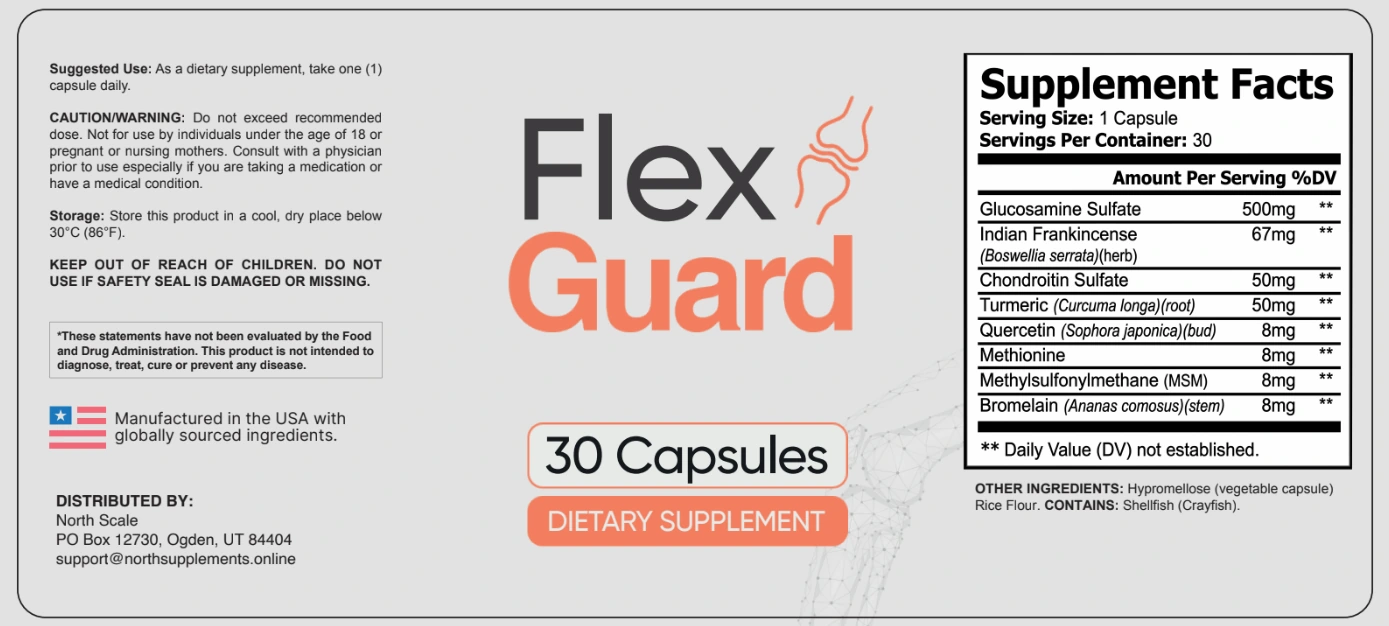
The FlexGuard panel, reproduced
Eight rows, a serving size, a container count and two lines beneath.
| Row | Amount per capsule | % Daily Value |
|---|---|---|
| Glucosamine Sulfate | 500 mg | † |
| Indian Frankincense (Boswellia serrata) (herb) | 67 mg | † |
| Chondroitin Sulfate | 50 mg | † |
| Turmeric (Curcuma longa) (root) | 50 mg | † |
| Quercetin (Sophora japonica) (bud) | 8 mg | † |
| Methionine | 8 mg | † |
| Methylsulfonylmethane (MSM) | 8 mg | † |
| Bromelain (Ananas comosus) (stem) | 8 mg | † |
Serving size: 1 capsule. Servings per container: 30. The dagger marks a row for which no Daily Value has been established.
Other ingredients: hypromellose (vegetable capsule), rice flour. Contains: shellfish (crayfish).
That is the panel in full. Nothing above has been summarised, reordered or rounded, and the row names are as the label writes them, including the plant part in brackets where the label gives one.
Adding the eight amounts gives 699 mg of declared active material per capsule, of which 500 mg is the glucosamine. The ingredients page takes each row in turn and sets it beside the amount its own research used.
Why every FlexGuard row carries a dagger instead of a percentage
One symbol repeated eight times, and what it actually means.
The third column of a Supplement Facts panel is the percentage of a Daily Value, and a Daily Value exists only where a reference intake has been set. That applies to vitamins and minerals. It does not apply to glucosamine, chondroitin, a botanical extract, an amino acid or an enzyme.
The federal labelling rule sets out the format and requires a symbol and a footnote wherever no Daily Value has been established. Every one of these eight rows is in that position, which is why the column looks the same all the way down.
The practical reading is simple. A dagger is not a warning and it is not a gap in the label: it means nobody has set a reference intake for that ingredient, so there is no percentage to print. What matters on this panel is the milligram column, and that column is complete.
It is the difference between a label you can check and one you cannot. A panel that prints a blend total instead of eight numbers is still legal and still common, and it makes every comparison on this website impossible. This one prints all eight.
The three FlexGuard lines printed below the panel
Four lines under the eight rows, and they carry more decisions than the rows do.
Other ingredients
Hypromellose, which is the capsule shell and is plant-derived, and rice flour, which is the filler that makes a small quantity of powder fill a capsule. Two inactives is a short list for this category.
Contains: Shellfish (Crayfish)
The allergen declaration. Glucosamine for supplements is manufactured from crustacean shell, and this label names the species rather than leaving it to be inferred. A controlled challenge in shrimp-allergic adults found no reactions to shellfish-derived glucosamine, and the declaration still governs. Side effects takes it further.
Caution and storage
“Do not exceed recommended dose. Not for use by individuals under the age of 18 or pregnant or nursing mothers. Consult with a physician prior to use especially if you are taking a medication or have a medical condition.” And then: “Store this product in a cool, dry place below 30°C (86°F).” Both are quoted in full on this website rather than paraphrased, because a paraphrase of a caution is a weaker caution.
Manufactured in the USA
The label's own wording is fuller than the short version: “Manufactured in the USA with globally sourced ingredients.” Both halves of that sentence are informative, and the testing and quality page says what each part of it does and does not establish.
Those four lines are where most of the answerable questions about a supplement live, and they are the part of a bottle that a photograph on a sales page almost never shows at a readable size.
Where the FlexGuard figures on this website come from
Two surfaces publish different things, and this website uses the stronger one.
Two surfaces publish information about this product and they do not publish the same thing.
The seller's front page names what the capsule supports and gives the pack prices. It does not reproduce the Supplement Facts panel. Anyone reading only that page would know what the product is sold for and not what is in it.
The label artwork that ships with the product prints the panel in full, including the allergen line and the caution. That is the stronger source and it is the one this website uses, which is why every figure on this site can be checked against the bottle that arrives rather than against a web page that may change.
The one thing that follows for a buyer: hold the bottle against this page. If a row differs, the bottle in your hand is the authority and this desk wants to hear about it at [email protected].
It will not estimate a figure the label does not print. No extract ratio is given for the boswellia or the turmeric and no enzyme activity figure for the bromelain, so this website prints none. The FTC’s guidance is clear about substantiation, and an invented standardisation figure would be the easiest thing on this site to get wrong and the hardest to notice.
How to read any panel, using FlexGuard as the worked example
Seven steps that work on any bottle in this category, not just this one.
- Find the serving size first. Every number on a panel is per serving, and a serving is not always one capsule. Here it is.
- Multiply by the servings you take. One a day here, so the panel figures are the daily figures. On a three-capsule product they are not.
- Add the actives up. If the total is a few hundred milligrams, the product is a broad formula at small amounts. If it is two grams, it is a narrow one at large amounts.
- Check for a blend. A row reading proprietary blend with one number after it means the individual amounts are not disclosed, and no comparison is possible.
- Read the other-ingredients line. Capsule material, fillers and the allergen declaration all live there.
- Then read the front of the bottle. In that order, because the front is marketing and the panel is a legal document.
- NCCIH's guidance on using supplements sensibly covers the same ground for somebody buying their first one.
FlexGuard panel: short answers
What is the serving size?
One capsule. Servings per container: 30, so a bottle is a calendar month at the label dose.
Why does every row have a dagger against it?
Because no Daily Value has been established for any of the eight. A Daily Value exists for vitamins and minerals, and nothing on this panel is either.
What are the other ingredients?
Hypromellose, which is the vegetable capsule shell, and rice flour. Nothing else.
Does the panel print an expiry date?
No. The best-before date and the lot code are printed on the bottle itself, usually on the base, rather than inside the panel.
Is the panel on the seller's website?
Not on the front page, which names what the capsule supports and stops there. The panel is on the label artwork that ships with the product, and it is reproduced in full on this page.
Who publishes this FlexGuard website?
- Code of Federal Regulations, Title 21, Section 101.36: Nutrition labeling of dietary supplements. Office of the Federal Register. https://www.ecfr.gov/current/title-21/chapter-I/subchapter-B/part-101/subpart-G/section-101.36
- Villacis J, Rice TR, Bucci LR, et al. Do shrimp-allergic individuals tolerate shrimp-derived glucosamine? Clin Exp Allergy. 2006;36(11):1457-61. PMID 17083356. https://pubmed.ncbi.nlm.nih.gov/17083356/
- Federal Trade Commission. Health Products Compliance Guidance. December 2022. https://www.ftc.gov/business-guidance/resources/health-products-compliance-guidance
- National Center for Complementary and Integrative Health. Using Dietary Supplements Wisely. https://www.nccih.nih.gov/health/using-dietary-supplements-wisely
The FlexGuard panel is on this page and on the bottle
Eight rows, one serving, thirty servings a bottle, and sixty days from purchase to change your mind.
Two bottles $158 · six bottles $294 · 60 days from purchase
Order FlexGuard On The Official WebsiteOne capsule a day · 30 per bottle · lot FLE-26/FL-2166