FlexGuard Official Website › FlexGuard Ingredients
FlexGuard IngredientsFlexGuard Ingredients: What Is in Each Capsule
FlexGuard has eight named ingredients in one daily capsule, each with its own printed amount.
Glucosamine sulfate 500 mg, Boswellia serrata 67 mg, chondroitin sulfate 50 mg and turmeric root 50 mg, plus quercetin, methionine, MSM and bromelain at 8 mg each, for 699 mg in total.
For the full label, see the supplement facts panel.
Eight rows, one capsule, and a printed number against every name. This page takes them in panel order and sets each beside the amount its own published research used.
The FlexGuard panel adds up to one number worth knowing
Before the individual rows, the one figure that describes the whole capsule.
Add the eight printed amounts: 500 plus 67 plus 50 plus 50 plus four rows of 8. The answer is 699 mg of active material in one capsule a day.
500 of those 699 mg are glucosamine sulfate. The other seven share 199 mg, and four of them weigh 8 mg each. Half a gram of one thing, then a scattering.
The arithmetic is only possible because the label prints every figure. Many products in this category publish a blend total instead, which means the same sum cannot be done at all.
| Row | Amount | Share of the capsule |
|---|---|---|
| Glucosamine Sulfate | 500 mg | 72% |
| Indian Frankincense (Boswellia serrata) (herb) | 67 mg | 10% |
| Chondroitin Sulfate | 50 mg | 7% |
| Turmeric (Curcuma longa) (root) | 50 mg | 7% |
| Quercetin (Sophora japonica) (bud) | 8 mg | 1% |
| Methionine | 8 mg | 1% |
| Methylsulfonylmethane (MSM) | 8 mg | 1% |
| Bromelain (Ananas comosus) (stem) | 8 mg | 1% |
Percentages are of the 699 mg of declared actives, not of the capsule's total weight, which also includes the shell and the rice flour.
Serving size on this panel is a single capsule, so every amount above is what you get in one swallow. In a category where 1,500 mg of glucosamine usually arrives as three or four capsules, that is a real convenience. How to take it covers the routine.
What is in FlexGuard, row by row
Panel order, from the largest amount to the smallest, with the research amount beside each one.
Glucosamine Sulfate
500 mgAn amino sugar the body makes from glucose and uses to build the glycosaminoglycans in cartilage. As a supplement it is manufactured from crustacean shell, which is why the allergen line on this panel reads crayfish.
It is the most-studied single ingredient here, and the picture is mixed. The Cochrane review pooled twenty studies in 2,570 people and found the outcome depended on which preparation was tested: the Rotta glucosamine sulfate product beat placebo, pooled non-Rotta preparations did not. A three-year trial of 1,500 mg a day reported changes in symptoms and joint space, while GAIT, in 1,583 people, found no significant benefit over placebo at six months.
Every one of those trials used 1,500 mg a day. This row is 500 mg.
Indian Frankincense
Boswellia serrata, herb67 mgThe gum resin of the frankincense tree, used in Ayurvedic medicine and studied for joint comfort on the strength of its boswellic acids, of which AKBA is the one most often standardised for.
Two trials set the amounts. A 2003 crossover study used 333 mg three times a day and reported less knee pain and greater walking distance. The 5-Loxin trial used a 30 per cent AKBA extract at 100 mg and 250 mg a day for ninety days, funded by that extract's maker. NCCIH calls the field small and uneven.
At 67 mg this is the closest row to a researched amount. No extract ratio and no AKBA percentage are printed, so the comparison is indicative.
Chondroitin Sulfate
50 mgA long-chain glycosaminoglycan found in cartilage, usually made from bovine trachea or fish cartilage. It is glucosamine's traditional partner and is proposed to help cartilage hold water.
The Cochrane review of chondroitin pooled forty-three randomised trials in 9,110 people. It found a small improvement in pain against placebo, graded low quality, and noted that the effect shrank in the larger and better-conducted studies. The amounts in that literature run from 800 to 1,200 mg a day.
This row is 50 mg, which is roughly a sixteenth of the lower end of that range.
Turmeric
Curcuma longa, root50 mgThe rhizome that colours curry, and the source of the curcuminoids that carry its research. The distinction that decides this row is between root powder and a standardised extract: curcuminoids are a few per cent of the root by weight and the great majority of a standardised extract.
A 2016 meta-analysis of the joint trials found the studies typically used around 1,000 mg a day of curcuminoids. A 367-person trial used 1,500 mg a day of a standardised extract and reported results comparable to ibuprofen. NCCIH adds the detail that decides it: curcumin is poorly absorbed alone.
The label names the root, and fifty milligrams of root is a different proposition from fifty of a standardised extract.
Quercetin
Sophora japonica, bud8 mgA flavonoid present in onions, apples, capers and tea, extracted for supplements from the flower bud of the Japanese pagoda tree. A normal mixed diet supplies somewhere in the tens of milligrams a day.
The German federal institute's safety review describes supplement intakes from 250 mg to 1,500 mg a day and concentrates its safety questions at the upper end. Work on absorption shows how little of an oral dose reaches circulation.
Eight milligrams sits below what a plate of onions supplies.
Methionine
8 mgAn essential sulfur-containing amino acid. The body cannot make it, so it comes from dietary protein: a single egg carries a few hundred milligrams and a chicken breast several times that.
Its place on joint labels is indirect: methionine is the precursor the body converts into S-adenosylmethionine, and it is SAMe that carries the joint evidence. A meta-analysis of the SAMe trials found it comparable to anti-inflammatories at around 1,200 mg a day.
No trial has tested methionine itself for joint comfort, and 8 mg of methionine is not 8 mg of SAMe.
Methylsulfonylmethane
MSM8 mgAn organic sulfur compound found in small amounts in food and made industrially for supplements. It is one of the two or three best-selling joint ingredients in the United States.
The unit is the whole story. A 2006 pilot trial gave fifty people 3 g twice a day. A 2011 randomised study used 1.125 g three times a day, and a 2017 review describes a literature running from 1.5 g to 6 g a day.
This row is 8 mg, in different units from its own research.
Bromelain
Ananas comosus, stem8 mgA mixture of protein-digesting enzymes extracted from pineapple stem, used in Europe for swelling after injury and surgery and sold in units of enzyme activity as often as in milligrams.
A review of its osteoarthritis studies found the trials small and the doses in the hundreds of milligrams a day. It is also the row most likely to matter to anyone on an anticoagulant.
The panel prints 8 mg and no enzyme activity figure.
What the FlexGuard artwork leaves out, and what the panel settles
The seller's ingredient graphic shows six. The printed panel shows eight.
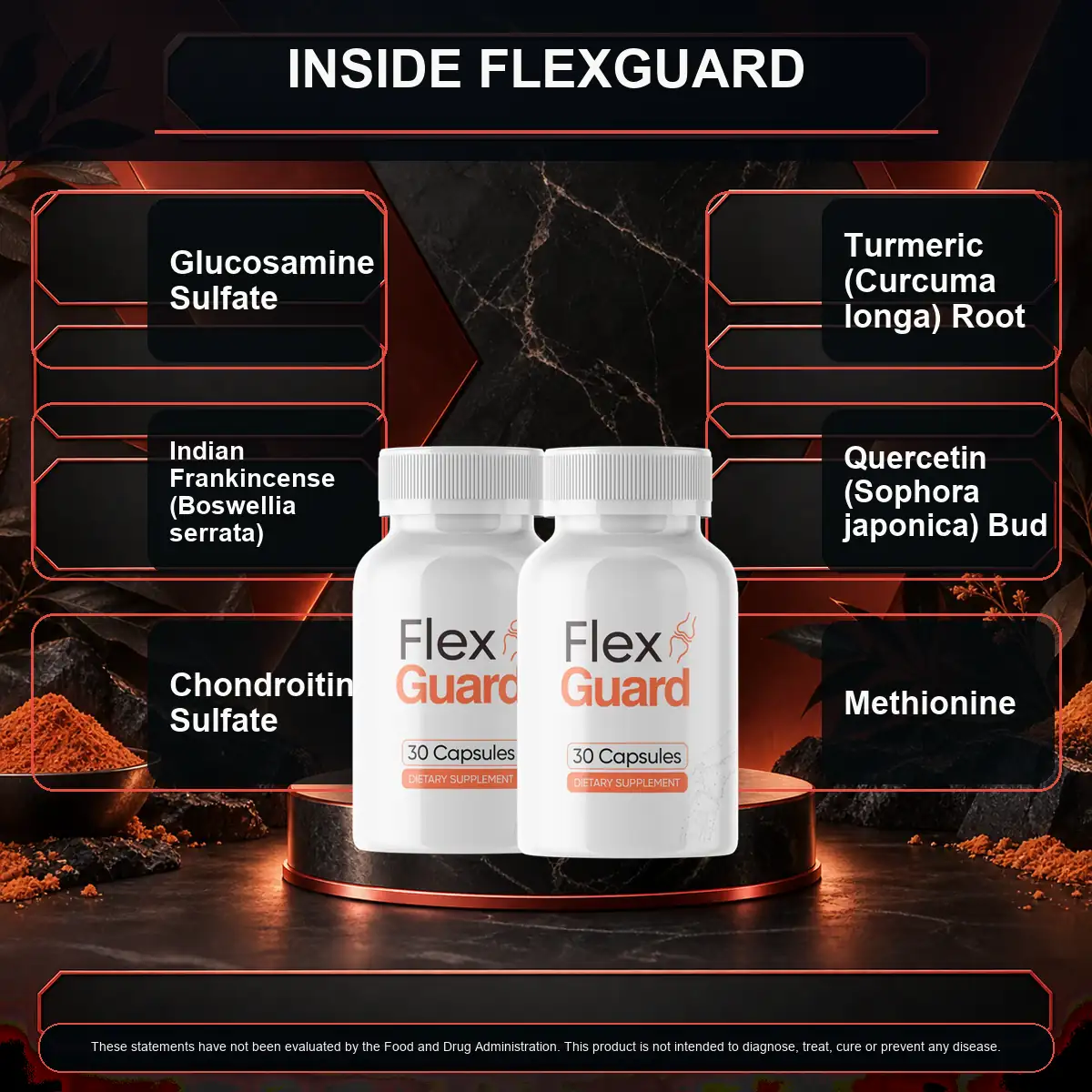
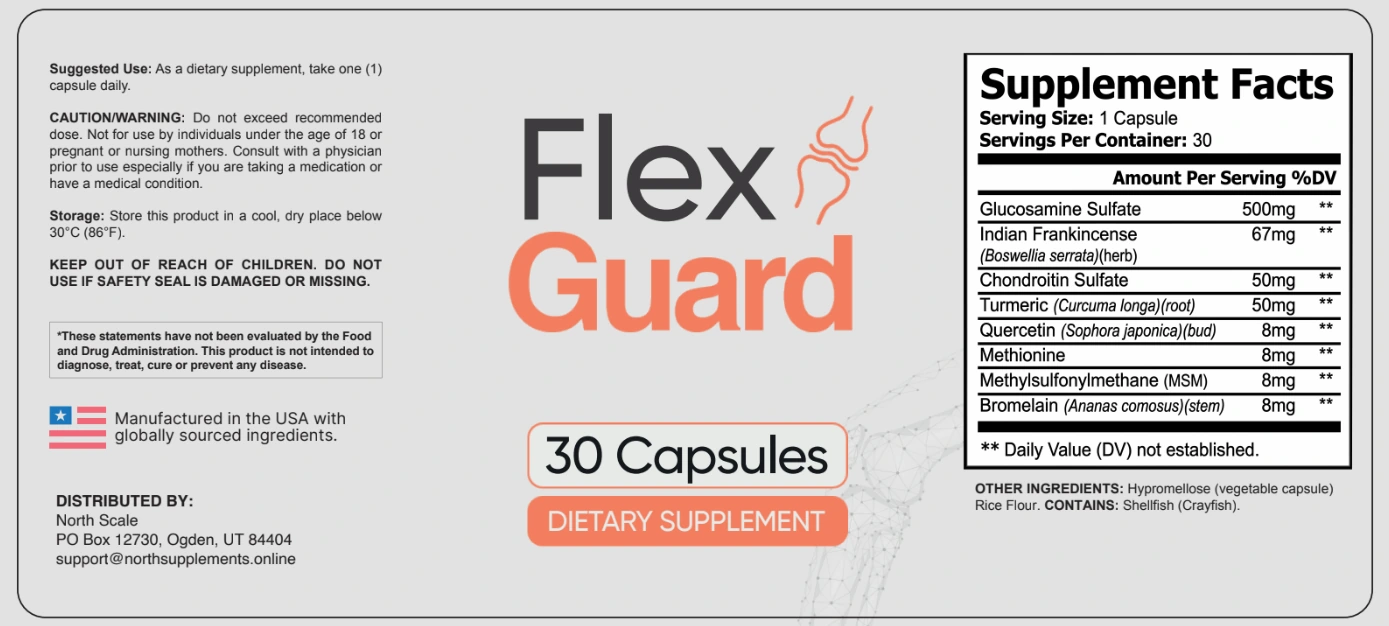
Marketing artwork and a Supplement Facts panel do different jobs, and where they differ the panel wins. The practical consequence is small here: both missing rows are 8 mg, and the arithmetic on this page already counts them.
Two useful things are absent. There is no extract ratio or standardisation figure for the boswellia or the turmeric, and there is no enzyme activity figure for the bromelain. Those are the numbers that would let two of these rows be matched exactly to their trials, and a reader should treat those comparisons as indicative.
What is not in FlexGuard
Six things worth confirming, because a front label rarely mentions any of them.
- No proprietary blend. Every row has its own number.
- No stimulant. No caffeine, no green tea extract, nothing felt as a lift.
- No sweetener, flavouring or colouring. The only inactives are the shell and rice flour.
- No gelatin. The shell is hypromellose. The glucosamine inside it is still crustacean-derived, so the product is not vegan or vegetarian.
- No collagen, no hyaluronic acid, no vitamin D. Three things buyers often expect in a joint capsule, none of them on this panel.
- No declared allergen other than shellfish.
A buyer comparing this capsule with another should read the panel page alongside it rather than the front of either bottle, because a front label in this category rarely carries a number.
FlexGuard ingredients: short answers
How many ingredients are in FlexGuard?
Eight, and the panel prints an amount for every one. Together they come to 699 mg in a single capsule.
Which ingredient is the largest?
Glucosamine sulfate at 500 mg, which is seventy-one per cent of the capsule's active weight. The other seven share 199 mg.
Is the glucosamine from shellfish?
Yes. The panel prints “Contains: Shellfish (Crayfish)”. Most commercial glucosamine is made from crustacean shell, and this label says which one.
Does the label say how concentrated the boswellia is?
No. It names the plant and the part, Boswellia serrata herb, and prints 67 mg. No extract ratio and no AKBA percentage appear, so the row cannot be matched exactly to the trials that used a standardised extract.
Is there caffeine or a stimulant in it?
No. Nothing on this panel is a stimulant, and there is no caffeine, no sweetener and no flavouring.
Who publishes this FlexGuard website?
- Towheed TE, Maxwell L, Anastassiades TP, et al. Glucosamine therapy for treating osteoarthritis. Cochrane Database Syst Rev. 2005;2005(2):CD002946. PMID 15846645. https://pubmed.ncbi.nlm.nih.gov/15846645/
- Reginster JY, Deroisy R, Rovati LC, et al. Long-term effects of glucosamine sulphate on osteoarthritis progression: a randomised, placebo-controlled clinical trial. Lancet. 2001;357(9252):251-6. PMID 11214126. https://pubmed.ncbi.nlm.nih.gov/11214126/
- Clegg DO, Reda DJ, Harris CL, et al. Glucosamine, chondroitin sulfate, and the two in combination for painful knee osteoarthritis. N Engl J Med. 2006;354(8):795-808. PMID 16495392. https://pubmed.ncbi.nlm.nih.gov/16495392/
- Singh JA, Noorbaloochi S, MacDonald R, et al. Chondroitin for osteoarthritis. Cochrane Database Syst Rev. 2015;1(1):CD005614. PMID 25629804. https://pubmed.ncbi.nlm.nih.gov/25629804/
- Kimmatkar N, Thawani V, Hingorani L, et al. Efficacy and tolerability of Boswellia serrata extract in treatment of osteoarthritis of knee: a randomized double blind placebo controlled trial. Phytomedicine. 2003;10(1):3-7. PMID 12622457. https://pubmed.ncbi.nlm.nih.gov/12622457/
- Sengupta K, Alluri KV, Satish AR, et al. A double blind, randomized, placebo controlled study of the efficacy and safety of 5-Loxin for treatment of osteoarthritis of the knee. Arthritis Res Ther. 2008;10(4):R85. PMID 18667054. https://pubmed.ncbi.nlm.nih.gov/18667054/
- National Center for Complementary and Integrative Health. Boswellia: Usefulness and Safety. https://www.nccih.nih.gov/health/boswellia
- Daily JW, Yang M, Park S. Efficacy of turmeric extracts and curcumin for alleviating the symptoms of joint arthritis: a systematic review and meta-analysis of randomized clinical trials. J Med Food. 2016;19(8):717-29. PMID 27533649. https://pubmed.ncbi.nlm.nih.gov/27533649/
- Kuptniratsaikul V, Dajpratham P, Taechaarpornkul W, et al. Efficacy and safety of Curcuma domestica extracts compared with ibuprofen in patients with knee osteoarthritis: a multicenter study. Clin Interv Aging. 2014;9:451-8. PMID 24672232. https://pubmed.ncbi.nlm.nih.gov/24672232/
- National Center for Complementary and Integrative Health. Turmeric: Usefulness and Safety. https://www.nccih.nih.gov/health/turmeric
- Andres S, Pevny S, Ziegenhagen R, et al. Safety aspects of the use of quercetin as a dietary supplement. Mol Nutr Food Res. 2018;62(1). PMID 29127724. https://pubmed.ncbi.nlm.nih.gov/29127724/
- Guo Y, Bruno RS. Endogenous and exogenous mediators of quercetin bioavailability. J Nutr Biochem. 2015;26(3):201-10. PMID 25468612. https://pubmed.ncbi.nlm.nih.gov/25468612/
- Soeken KL, Lee WL, Bausell RB, et al. Safety and efficacy of S-adenosylmethionine (SAMe) for osteoarthritis. J Fam Pract. 2002;51(5):425-30. PMID 12019049. https://pubmed.ncbi.nlm.nih.gov/12019049/
- Kim LS, Axelrod LJ, Howard P, et al. Efficacy of methylsulfonylmethane (MSM) in osteoarthritis pain of the knee: a pilot clinical trial. Osteoarthritis Cartilage. 2006;14(3):286-94. PMID 16309928. https://pubmed.ncbi.nlm.nih.gov/16309928/
- Debbi EM, Agar G, Fichman G, et al. Efficacy of methylsulfonylmethane supplementation on osteoarthritis of the knee: a randomized controlled study. BMC Complement Altern Med. 2011;11:50. PMID 21708034. https://pubmed.ncbi.nlm.nih.gov/21708034/
- Butawan M, Benjamin RL, Bloomer RJ. Methylsulfonylmethane: applications and safety of a novel dietary supplement. Nutrients. 2017;9(3). PMID 28300758. https://pubmed.ncbi.nlm.nih.gov/28300758/
- Brien S, Lewith G, Walker A, et al. Bromelain as a treatment for osteoarthritis: a review of clinical studies. Evid Based Complement Alternat Med. 2004;1(3):251-257. PMID 15841258. https://pubmed.ncbi.nlm.nih.gov/15841258/
- Code of Federal Regulations, Title 21, Section 101.36: Nutrition labeling of dietary supplements. Office of the Federal Register. https://www.ecfr.gov/current/title-21/chapter-I/subchapter-B/part-101/subpart-G/section-101.36
Read the FlexGuard panel, then decide
Eight actives, 699 mg in one capsule, every amount printed on the bottle and reproduced on this website. Sixty days from purchase to change your mind.
Two bottles $158 · six bottles $294 · 60 days from purchase
Order FlexGuard On The Official WebsiteOne capsule a day · 30 per bottle · lot FLE-26/FL-2166