FlexGuard Official Website › Blog › Boswellia: The Row That Fits
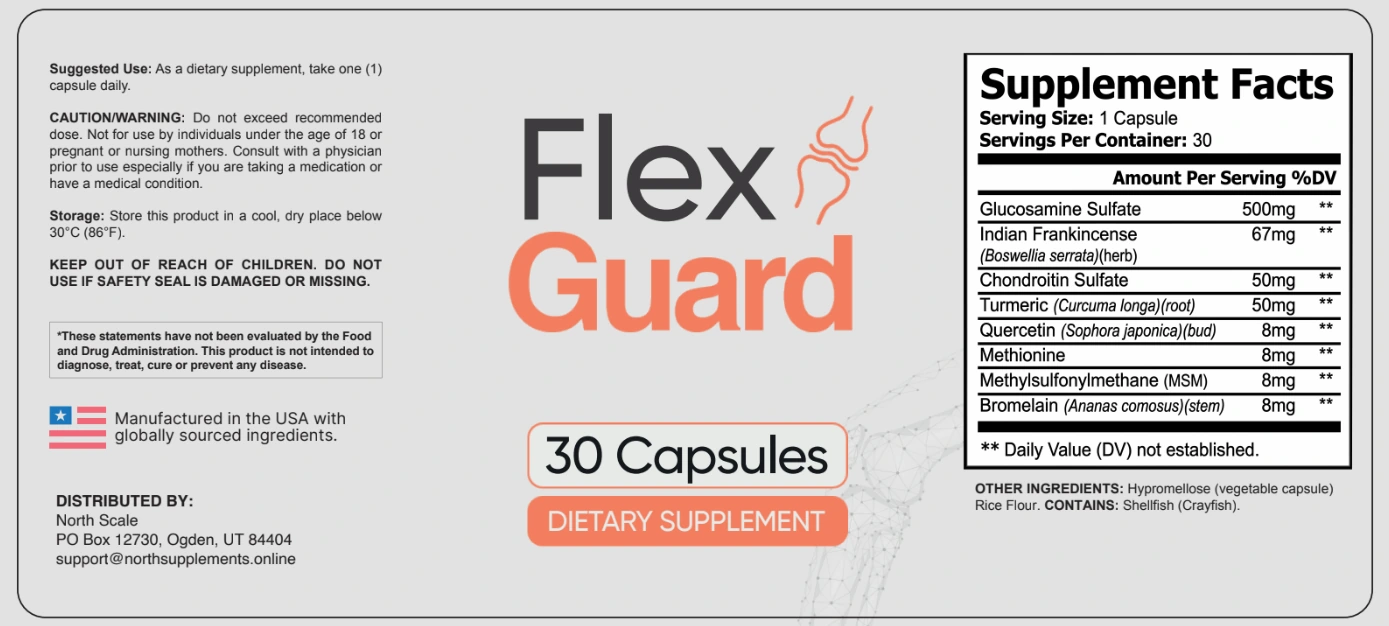
Boswellia At 67 mg: The One Row On This Panel That Fits Its Research
Most of this article's job is to criticise doses. This one does the opposite. Boswellia serrata at 67 mg sits in the same order of magnitude as the extract its randomised trials used, which no other row on this panel can say, and it deserves to be said as plainly as the criticisms elsewhere.
- Boswellia serrata is the gum resin of the frankincense tree, and its active compounds are boswellic acids, of which AKBA is the one usually standardised for.
- A 90-day randomised trial of an extract standardised to 30 per cent AKBA reported improvements at 100 mg and 250 mg a day.
- FlexGuard carries 67 mg, which is the same order of magnitude as the lower of those.
- The label prints no extract ratio and no AKBA percentage, so the comparison is indicative rather than exact.
- That trial was funded by the maker of the extract it tested, which is worth carrying alongside the result rather than instead of it.
What boswellia is
Boswellia serrata is a tree that grows in the dry hills of India, and the material used in supplements is its gum resin, tapped from the bark much as rubber is tapped. It is the same family of resins that produces frankincense, and it has been used in Ayurvedic medicine for a very long time.
The compounds of interest are boswellic acids. The one most studied is 3-O-acetyl-11-keto-beta-boswellic acid, mercifully abbreviated to AKBA, which is studied for its effect on the 5-lipoxygenase enzyme and the inflammatory signalling that runs through it.
That mechanism is different from everything else on this panel. Glucosamine and chondroitin supply cartilage components; boswellia acts on signalling. Neither rebuilds anything, and the two ideas are frequently sold together for that reason.
NCCIH's summary of the field is fair and short: the research exists, the trials are small, and the quality is uneven.
The two trials that set the amounts
Two studies define what a researched amount of boswellia looks like, and they are at different scales because they used different materials.
A 2003 crossover trial gave thirty people with knee osteoarthritis 333 mg of Boswellia serrata extract three times a day, so 999 mg daily, in a design where each person received both the extract and placebo in turn. It reported less knee pain, greater walking distance and more knee flexion on the extract.
The 5-Loxin trial used a different material: an extract standardised to 30 per cent AKBA, at 100 mg and 250 mg a day for ninety days in seventy-five people. It reported improvements in pain and function at both amounts, with the higher one producing changes sooner.
The difference between 999 mg and 100 mg is not a contradiction. A gum resin extract and an extract concentrated to 30 per cent AKBA are different materials, and concentrating the active lets you use less of it. That is the whole point of standardisation.
| Study | Preparation | Daily amount | Duration | What it reported |
|---|---|---|---|---|
| The 2003 crossover trial | Boswellia serrata extract | 999 mg, as 333 mg three times | 8 weeks per arm | Less knee pain, greater walking distance and more flexion than placebo |
| The 5-Loxin trial | Extract standardised to 30% AKBA | 100 mg and 250 mg | 90 days | Improvements in pain and function at both amounts, funded by the extract's maker |
| FlexGuard | Boswellia serrata, herb, no ratio printed | 67 mg | Not trialled | The closest row on this panel to a researched amount |
Two trials at two scales, because a concentrated extract and a gum resin extract are not the same material. The 67 mg on this label is in the neighbourhood of the concentrated one and well below the other.
Who paid for the encouraging one
This belongs in the article rather than in a footnote. The 5-Loxin trial was funded by the company that makes 5-Loxin.
Industry funding of a trial is not disqualifying and it is not unusual. A great deal of supplement research is funded by the people who sell the ingredient, because nobody else will pay for it. What it is, reliably, is a reason to weight a single positive result less heavily than an independent replication of it.
There has been no large independent replication of the 5-Loxin result. The 2003 crossover was independent of it and used a different material, so the two are supporting rather than confirming each other.
So the honest position on boswellia is: the most encouraging plant row on this panel, on a small evidence base, one of whose two supporting trials was paid for by the ingredient's manufacturer. That is better than most of this category can say and it is not a settled question.
Because a website that quotes a manufacturer-funded trial without mentioning who funded it has told you something true and left out the thing that would let you weigh it. The funding is in the paper; it should be in the summary of the paper too.
One row on the FlexGuard panel fits its research
Boswellia at 67 mg, in the same order of magnitude as the extract its trials used. The other seven rows are on this website too, with the same arithmetic applied.
Two bottles $158 · six bottles $294 · 60 days from purchase
Order FlexGuard On The Official WebsiteOne capsule a day · 30 per bottle · lot FLE-26/FL-2166
Reading the 67 mg row
Against the 5-Loxin amounts, 67 mg sits below 100 mg and well below 250 mg. It is the same order of magnitude as the lower of the two, which is a genuinely different situation from being three orders below.
Against the 2003 crossover's 999 mg of gum resin extract, 67 mg is nowhere near. But comparing those two directly is the error the whole standardisation question exists to prevent: the amounts differ because the materials do.
Which comparison applies depends entirely on what the 67 mg on this label actually is, and that is the next section.
The figure the label does not print
The panel reads Indian Frankincense (Boswellia serrata)(herb), 67 mg. It names the plant, it names the part and it prints the weight.
What it does not print is an extract ratio or an AKBA percentage. Without one of those, a reader cannot tell whether 67 mg is a concentrated extract comparable to the 5-Loxin material, a less concentrated extract, or something closer to the gum resin.
This desk will not estimate it. Where a label prints no figure, this website prints none, and the consequence is that the comparison in this article is indicative rather than exact. Saying that is more useful than filling the gap with a guess that would read as a fact.
- If it is a 30 per cent AKBA extract, 67 mg is two thirds of the lower trial amount and this row is the strongest thing on the panel.
- If it is a less concentrated extract, 67 mg supplies proportionally less AKBA and the comparison weakens.
- If it is closer to gum resin, 67 mg is a small fraction of the 2003 trial's daily amount.
- What the label establishes either way is the plant, the part and the weight, which is three of the four things needed.
- What would settle it is one line on the panel, and it is the single most useful line this label could add.
How boswellia compares with the other seven rows
This is the comparison that makes the row matter, and it is best seen all at once.
| Row | Amount | Order of magnitude against its research |
|---|---|---|
| Boswellia serrata | 67 mg | Same order of magnitude |
| Glucosamine sulfate | 500 mg | One order below |
| Chondroitin sulfate | 50 mg | One order below |
| Turmeric root | 50 mg | One to two orders below, and root rather than extract |
| Quercetin, methionine, MSM, bromelain | 8 mg each | Two to three orders below, or untested |
One row of eight clears the bar. That is the finding this article is built on, and it is a more useful thing to know than a general complaint about small doses.
One row of eight clears the bar. That is not a triumphant finding and it is a real one: it means this panel is not simply a glucosamine capsule with decoration, which is what the four 8 mg rows on their own would suggest.
It also means the strongest argument for this product is not the one on the front of the bottle. Eight ingredients is the selling point; one ingredient at a plausible amount, alongside 500 mg of the best-studied compound in the category, is the actual case.
Why turmeric on the same panel does worse
Turmeric sits directly beneath boswellia at 50 mg, and it fails the same test that boswellia passes, for a reason worth understanding.
Curcuminoids are a few per cent of turmeric root by weight and the great majority of a standardised extract. So 50 mg of root and 50 mg of extract differ by a factor of twenty or more in the compound that carries the research.
The joint meta-analysis of turmeric drew on trials using around 1,000 mg a day of curcuminoids. Fifty milligrams of root supplies a small fraction of one per cent of that.
The label names the root and prints no extract ratio, so this website treats it as root. That is the conservative reading and it is the only one the label supports. The same missing line that makes the boswellia row indicative makes the turmeric row unflattering.
What one good row is worth
- It changes how the product should be described. Not a broad formula and not a single-ingredient capsule, but glucosamine plus one plant row at a plausible amount.
- It gives a buyer something specific to want. Somebody interested in boswellia has a reason to look at this bottle that does not depend on the other seven rows.
- It does not fix the rest of the panel. Four rows at 8 mg are still four rows at 8 mg, and the ingredients page says so.
- It is not a health claim. Two small trials, one manufacturer-funded, is an encouraging signal rather than a result, and the 2019 rheumatology guideline is a reminder of how much evidence a clinical recommendation actually needs.
- It is the kind of thing a label can only tell you if it prints numbers. On a proprietary blend, none of this article could be written.
This is product information written from a printed label, not medical advice. FlexGuard is a dietary supplement and it does not treat, prevent or manage arthritis or any other diagnosed condition. Joint pain that is new, severe, on one side only, hot, swollen or that followed an injury needs examining rather than supplementing, and anyone taking a prescription medicine should raise a new supplement with the person who prescribed it.
References
- Sengupta K, Alluri KV, Satish AR, et al. A double blind, randomized, placebo controlled study of the efficacy and safety of 5-Loxin for treatment of osteoarthritis of the knee. Arthritis Res Ther. 2008;10(4):R85. PMID 18667054. https://pubmed.ncbi.nlm.nih.gov/18667054/
- Kimmatkar N, Thawani V, Hingorani L, et al. Efficacy and tolerability of Boswellia serrata extract in treatment of osteoarthritis of knee: a randomized double blind placebo controlled trial. Phytomedicine. 2003;10(1):3-7. PMID 12622457. https://pubmed.ncbi.nlm.nih.gov/12622457/
- National Center for Complementary and Integrative Health. Boswellia: Usefulness and Safety. https://www.nccih.nih.gov/health/boswellia
- Daily JW, Yang M, Park S. Efficacy of turmeric extracts and curcumin for alleviating the symptoms of joint arthritis: a systematic review and meta-analysis of randomized clinical trials. J Med Food. 2016;19(8):717-29. PMID 27533649. https://pubmed.ncbi.nlm.nih.gov/27533649/
- Kolasinski SL, Neogi T, Hochberg MC, et al. 2019 American College of Rheumatology/Arthritis Foundation guideline for the management of osteoarthritis of the hand, hip, and knee. Arthritis Rheumatol. 2020;72(2):220-233. PMID 31908163. https://pubmed.ncbi.nlm.nih.gov/31908163/
The FlexGuard panel prints the plant and the part
Boswellia serrata, herb, 67 mg. One row of eight in the neighbourhood of its own research, and this website says which.
Two bottles $158 · six bottles $294 · 60 days from purchase
Order FlexGuard On The Official WebsiteOne capsule a day · 30 per bottle · lot FLE-26/FL-2166