FlexGuard Official Website › Blog › The Dagger Column
The Dagger Column: Why No Row On This Panel Has A Daily Value
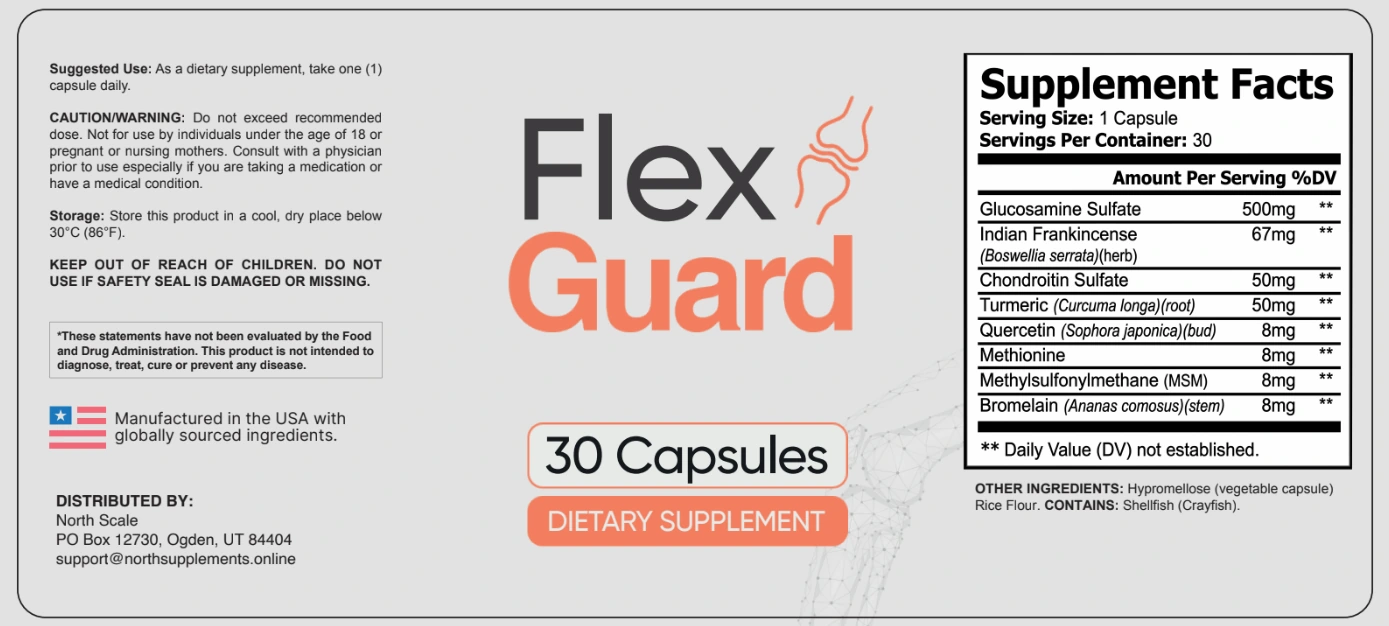
Every row on this Supplement Facts panel carries a symbol instead of a percentage in its third column. That is not a gap in the label and it is not a warning. It means something specific, it is true of almost every joint supplement sold, and knowing what it means changes which column you read.
- A Daily Value is a reference intake set for a population, and it exists for vitamins, minerals and a handful of macronutrients.
- None of the eight ingredients on this panel is a vitamin or a mineral, so none of them has one.
- The labelling rule requires a symbol and a footnote wherever no Daily Value has been established, which is why the column looks the same all the way down.
- The symbol is not a warning, a caution or an admission. It is a statement about what reference intakes exist.
- On a joint supplement the milligram column carries the whole informational load, and it is the one to read.
The three columns of a panel
A Supplement Facts panel is a prescribed format rather than a design choice. The federal labelling rule sets out what has to appear, in what order, and how a row with no established Daily Value is marked.
Three things run down the block: the name of each ingredient, the amount per serving, and the percentage of a Daily Value that amount represents. Above them sit the serving size and the number of servings in the container, which on this bottle are one capsule and thirty.
Most readers glance at the names and stop. The useful reading is the opposite way round.
| Column | What it is | How much it tells you |
|---|---|---|
| The row name | The ingredient, and often the plant part in brackets | A good deal. A named plant part is more than many labels give |
| The amount | Milligrams per serving | Almost everything. This is the column that can be set against a trial |
| The % Daily Value | A percentage, or a symbol saying none is established | On this panel, nothing at all. Eight symbols in a column |
Three columns, and on a joint supplement the middle one carries the entire informational load.
What a Daily Value actually is
A Daily Value is a single reference figure used on labels so that a number in milligrams can be turned into a percentage a shopper can use. It is a labelling convention built on population reference intakes rather than a personal requirement.
The important property is that one has to exist before it can be printed. Reference intakes have been set for vitamins, for minerals, and for a small group of macronutrients such as protein, fat and dietary fibre. Those are the categories where a percentage is meaningful, because somebody has established what a population needs.
For everything else there is no reference intake, so there is no percentage to calculate. That is the whole of it.
Why none of these eight has one
Run the panel against that rule and the result is immediate.
Glucosamine sulfate and chondroitin sulfate are structural compounds the body makes for itself; no intake has been established for either. Boswellia serrata and turmeric are botanical materials. Bromelain is an enzyme. Quercetin is a flavonoid found in food but not a required nutrient.
Methionine is the closest case, and it is instructive. It is an essential amino acid, so the body genuinely cannot make it and genuinely needs it from food. But the reference intake for protein is set for protein rather than for each amino acid within it, so a single amino acid on a supplement panel still has no Daily Value of its own.
Eight rows, eight symbols, and no exception.
| Kind of ingredient | Has a Daily Value | Example |
|---|---|---|
| Vitamins | Yes | Vitamin C, vitamin D, vitamin B6 |
| Minerals | Yes | Calcium, magnesium, zinc, iron |
| Some macronutrients | Yes | Protein, dietary fibre, total fat |
| Amino acids on their own | No | Methionine, the sixth row on this panel |
| Botanical extracts | No | Boswellia serrata, turmeric |
| Structural compounds | No | Glucosamine sulfate, chondroitin sulfate |
| Enzymes | No | Bromelain |
| Flavonoids | No | Quercetin |
A Daily Value exists where a reference intake has been set for a population. Eight rows on this panel, and not one of them is in a category that has one.
What the symbol means, and what it does not
This matters because the column is routinely misread in both directions.
- It does not mean the ingredient is unregulated. The panel format, the allergen declaration and the claims the label may make are all governed.
- It does not mean the amount is too small. That is a separate question, answered by the milligram column against the published trials.
- It does not mean the ingredient is unstudied. Glucosamine has one of the larger trial literatures in supplements, and NCCIH summarises it without any reference to a Daily Value.
- It does not mean the ingredient is risky. Safety questions are handled elsewhere: the German federal review of quercetin is an example of what that work looks like, and it is about intakes rather than percentages.
- It does mean one thing only: no reference intake has been established for that ingredient, so no percentage can be printed.
Pick up almost any joint supplement and the third column will look the same. A joint panel showing percentages is usually a formula that has added vitamin D or vitamin C alongside the joint ingredients, and those percentages describe the vitamins rather than anything the product is being sold for.
The FlexGuard panel is reproduced in full on this website
Eight rows, the amounts, the other-ingredients line and the allergen declaration, so the bottle can be checked before it is bought.
Two bottles $158 · six bottles $294 · 60 days from purchase
Order FlexGuard On The Official WebsiteOne capsule a day · 30 per bottle · lot FLE-26/FL-2166
The column that does the work
If the third column is inert, the second one carries everything, and that is the practical lesson of this article.
A milligram figure can be set against the amount a published trial used. That is the only comparison available on a joint supplement and it is a genuinely powerful one: the ingredients page runs it for all eight rows on this panel and the answers are not uniform.
It is also the column a proprietary blend removes. A blend prints several names and one combined total, which leaves the third column full of symbols and the second column missing. A panel like that cannot be read at all, and a great many products in this category ship one.
FlexGuard prints an amount for every row. That is the single feature that makes the rest of this website possible.
Where a percentage does turn up on a joint product
Three situations put a real number in that column, and it is worth recognising them.
Added vitamins. Vitamin D, vitamin C and vitamin K appear on some joint formulas, and those rows carry percentages because reference intakes exist for them. The percentage describes the vitamin and says nothing about the joint ingredients beside it.
Added minerals. Manganese and zinc turn up for the same reason and carry the same kind of figure.
A very high percentage. Some panels print several hundred per cent for a vitamin. That is a fact about the reference intake rather than about potency, and it is also where an upper intake becomes worth checking.
None of those three appears on this panel. There are no vitamins and no minerals on it at all, which is itself worth knowing if you expected vitamin D in a joint capsule.
What a panel is not required to tell you
Reading the columns properly leads to the other half of label literacy, which is the information a panel may leave out entirely.
- An extract ratio. A botanical row may print a weight and no concentration, which is the case for both botanicals here.
- A standardisation marker. An AKBA percentage for boswellia or a curcuminoid percentage for turmeric would make two rows comparable with their trials. Neither is printed.
- Enzyme activity. Bromelain is usually sold in activity units, and this panel gives a weight only.
- The source of an ingredient. That the glucosamine is crustacean-derived is inferable from the allergen line rather than stated in words.
- Any evidence at all. A panel records what is present. The FTC’s guidance governs what a seller may claim about it, which is a different document and a different question.
A label that volunteers more than the minimum is telling you something about the people who made it. So is one that volunteers exactly the minimum.
Six checks, in order
- Serving size first. Everything below it is per serving, and a serving is not always one capsule. Here it is.
- Then the milligram column. This is the one that can be checked against anything.
- Add the actives up. The total tells you whether the product is broad and small or narrow and large.
- Ignore the third column on a joint product. If it is all symbols, it is telling you the ingredients are not vitamins.
- Read the other-ingredients and allergen lines. Capsule material and declared allergens live there, beneath the block.
- Then read the front of the bottle. In that order, because the front is marketing and the panel is a legal document.
And when a symptom rather than a supplement is the actual question, MedlinePlus on osteoarthritis is a better five minutes than any label. Joint pain that is new, severe, one-sided, hot or swollen belongs in front of somebody who can examine it.
This is product information written from a printed label, not medical advice. FlexGuard is a dietary supplement and it does not treat, prevent or manage arthritis or any other diagnosed condition. Joint pain that is new, severe, on one side only, hot, swollen or that followed an injury needs examining rather than supplementing, and anyone taking a prescription medicine should raise a new supplement with the person who prescribed it.
References
- Code of Federal Regulations, Title 21, Section 101.36: Nutrition labeling of dietary supplements. Office of the Federal Register. https://www.ecfr.gov/current/title-21/chapter-I/subchapter-B/part-101/subpart-G/section-101.36
- National Center for Complementary and Integrative Health. Glucosamine and Chondroitin for Osteoarthritis: What You Need To Know. https://www.nccih.nih.gov/health/glucosamine-and-chondroitin-for-osteoarthritis
- Andres S, Pevny S, Ziegenhagen R, et al. Safety aspects of the use of quercetin as a dietary supplement. Mol Nutr Food Res. 2018;62(1). PMID 29127724. https://pubmed.ncbi.nlm.nih.gov/29127724/
- Federal Trade Commission. Health Products Compliance Guidance. December 2022. https://www.ftc.gov/business-guidance/resources/health-products-compliance-guidance
- MedlinePlus. Osteoarthritis. U.S. National Library of Medicine. https://medlineplus.gov/osteoarthritis.html
Read the FlexGuard milligram column, not the symbols
Eight amounts, printed on the bottle and reproduced here, with sixty days from purchase to change your mind.
Two bottles $158 · six bottles $294 · 60 days from purchase
Order FlexGuard On The Official WebsiteOne capsule a day · 30 per bottle · lot FLE-26/FL-2166