FlexGuard Official Website › Blog › Seventy-One Per Cent Of One Capsule
Seventy-One Per Cent Of One Capsule: How This Joint Panel Spends Its Budget
Five hundred of this capsule's 699 mg of declared actives are one ingredient. Seven others share the remaining 199 mg and four of them weigh 8 mg each. Read the panel as a budget rather than as an ingredient list and the formula becomes legible in about thirty seconds.
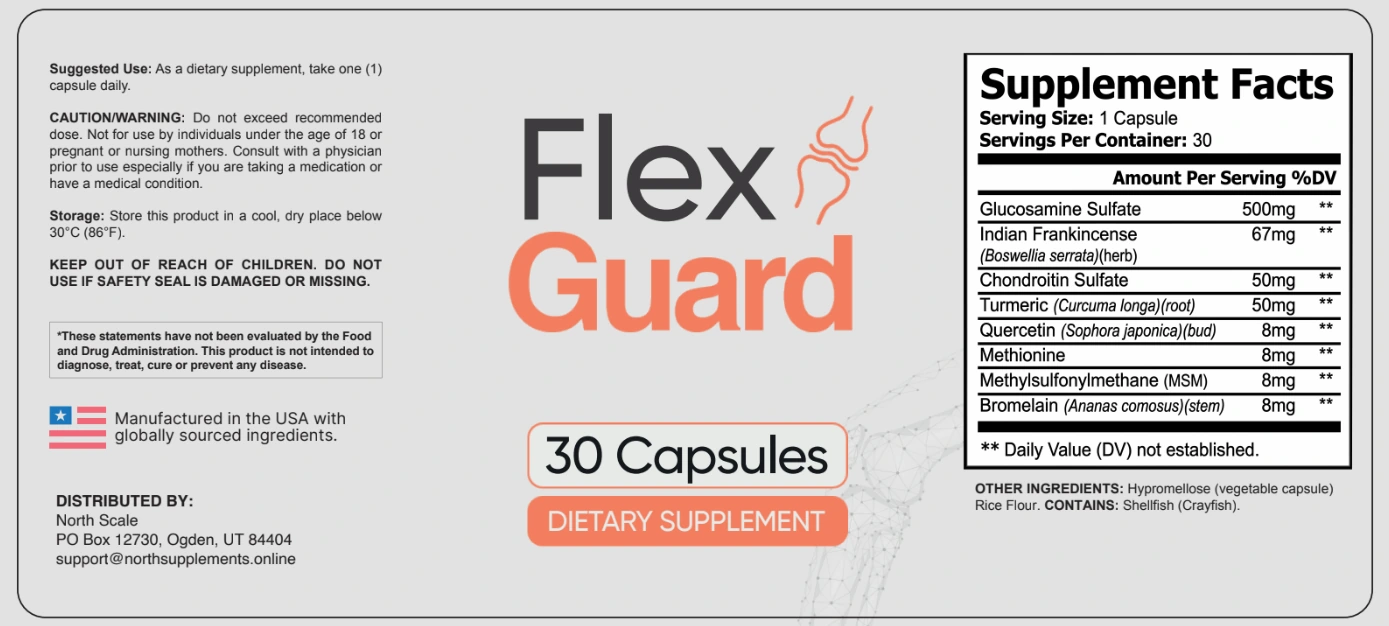
- Seventy-one per cent of this capsule's 699 mg of declared actives is one row: glucosamine sulfate at 500 mg.
- Boswellia takes another ten per cent. Chondroitin and turmeric take seven each, and four rows at 8 mg share under five per cent between them.
- A capsule holds roughly half a gram of powder, so that allocation is a budget rather than a wish list.
- Reading a panel as shares rather than as names tells you what the product actually is in one pass.
- None of this arithmetic is possible on a proprietary blend, which prints one total for several names.
A panel as a budget, not a list
A two-piece hard capsule comes in standard sizes, and the one used for most supplements holds somewhere around half a gram of powder. The exact fill weight depends on how dense the material is, how well it flows and how hard it is tamped, but the order of magnitude does not move: a capsule is a few hundred milligrams of space.
Part of that space is not available. A filler is usually needed so a small quantity of active powder fills the shell evenly, which is what the rice flour on this label is doing, and a flow agent is often needed so the machine can run at all.
So a joint panel is a budget of roughly half a gram, allocated across however many names the front of the bottle is going to carry. On this bottle 699 mg of declared actives went across eight rows, and the interesting question is not how many capsules a day it asks for but where those milligrams went.
One thing this article is deliberately not about: how often a dose is taken. Frequency is a separate question from allocation, and it does not change the arithmetic below.
Why 1,500 mg is the number that breaks everything
The trouble starts with the best-studied ingredient in the category.
The NIH-funded GAIT trial randomised 1,583 people to glucosamine at 1,500 mg a day, chondroitin at 1,200 mg, both, an anti-inflammatory or placebo. The Cochrane review pooled twenty studies and drew on the same daily figure. Whatever you think the literature shows, it is a literature about 1,500 mg a day.
Fifteen hundred milligrams is three capsules of nothing else. Add chondroitin at the 800 to 1,200 mg its own pooled trials used and you are at five or six capsules a day for two ingredients.
That is the fork in the road, and it arrives before any decision about which botanicals are fashionable or what the front label should say.
| What a formula wants to deliver | Daily amount | Roughly how many capsules |
|---|---|---|
| Glucosamine at its trial amount | 1,500 mg | 3, and nothing else fits |
| Glucosamine and chondroitin at theirs | 1,500 mg + 1,200 mg | 5 or 6 |
| MSM at the low end of its literature | 1.5 g | 3 on its own |
| A standardised turmeric extract | 1,000 mg of curcuminoids | 2 |
| Eight named ingredients in one capsule | 699 mg | 1 |
A common size 0 capsule holds roughly half a gram of powder, and the fill weight varies with how dense the material is. The right-hand column is an order of magnitude rather than a specification.
The two answers, and what each one costs
A formulator has exactly two ways out of that, and both are in every pharmacy in the country.
Depth: fewer rows, at the amounts the research used
Two ingredients, three or four capsules a day, and a panel that matches the literature row for row. The cost is the regimen: four capsules a day for two months is something a meaningful number of people will not complete, and a product nobody finishes produces no answer at all.
Breadth: more rows, at a fraction of the amounts
Eight ingredients, one capsule a day, and a panel where one row is in the neighbourhood of its research and the rest are below it. The cost is the amounts, and it is visible on the panel to anybody who knows what the trials used.
| Depth: two rows at their trial amounts | Breadth: eight rows, as on FlexGuard | |
|---|---|---|
| Capsules a day | 3 or 4 | 1 |
| Named ingredients | 2 | 8 |
| Amount per ingredient | The figure the trials used | A fraction of it, except one |
| What the front label says | Two words | Eight, which reads as more |
| What a buyer can check | Two numbers against two literatures | Eight numbers against eight literatures, if the panel prints them |
| The usual failure | A regimen abandoned in week three | A regimen completed at amounts nobody studied |
Neither column is the right answer in general. Which one is right depends entirely on whether you want one thing done at the studied amount or several things attempted.
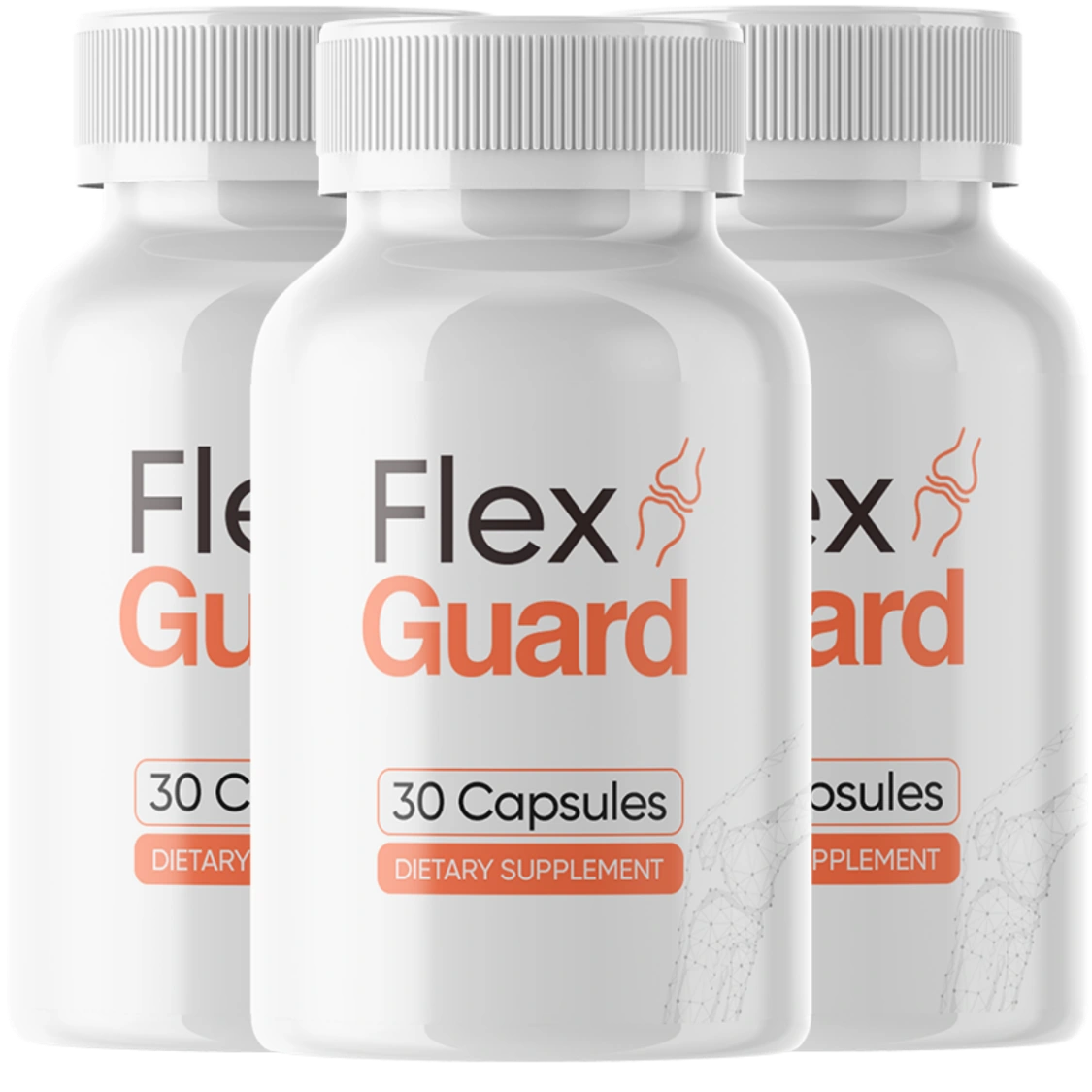
The FlexGuard panel shows exactly which choice it made
Eight rows, 699 mg, one capsule a day, and every amount printed so the trade is legible rather than hidden.
Two bottles $158 · six bottles $294 · 60 days from purchase
Order FlexGuard On The Official WebsiteOne capsule a day · 30 per bottle · lot FLE-26/FL-2166
What this panel spent its budget on
The arithmetic is short, because the label does it for you.
- Glucosamine sulfate, 500 mg. That is 500 of the capsule's 699 mg, or seventy-one per cent of the entire budget on one row.
- Boswellia serrata, 67 mg. Nearly ten per cent, and the only row in the same order of magnitude as the extract its own trials used.
- Chondroitin sulfate and turmeric root, 50 mg each. Seven per cent apiece.
- Quercetin, methionine, MSM and bromelain, 8 mg each. Thirty-two milligrams between them, under five per cent of the capsule for four of the eight names.
Read that list as a budget rather than as an ingredient list and the formula becomes legible. Seventy-one per cent went on the ingredient with the most research, ten per cent went on the botanical with the most direct joint evidence, and the remaining fifth was spread across six names, four of which are there in name.
Whether that is a good allocation is a judgement. What is not a judgement is that the allocation is printed, and that the ingredients page sets every row against the amount its own research used.
The argument for one a day, made honestly
There is a real case for breadth and it is not about marketing. It is about whether anybody actually takes the product.
Adherence is the quiet problem in this whole category. A joint supplement needs eight to twelve weeks before anybody could form a view, because that is the span the trials used, and a four-capsule regimen across that period is a great deal of remembering.
One capsule beside a kettle, taken at the same moment every morning, is a habit. Four capsules taken with meals is a routine, and routines are the things that lapse in the second week of a busy month.
So a defensible version of this formula's case runs: a smaller amount somebody actually takes for sixty days beats a larger amount they abandon on day nineteen. That argument is honest as far as it goes. What it cannot do is turn an untested amount into a tested one.
The Cochrane review of land-based exercise pooled fifty-four trials and found improvements in both pain and physical function in knee osteoarthritis. It has no capsule budget and no adherence advantage to trade away, and no ingredient in this category has a result of that size behind it.
Why breadth also sells better, which is not nothing
It would be naive to pretend the choice is made on pharmacology alone.
A front label listing eight ingredients reads as more generous than one listing two, and most buyers count names rather than milligrams. A product carrying MSM appears in searches for MSM whatever the amount, and MSM's own literature runs in grams a day, so the name is doing search work that the 8 mg could not do on its own.
None of that makes a breadth formula dishonest. It makes the panel the only place the question can be settled, which is why a label that prints eight numbers is worth more than a label that prints eight names.
The version of this you cannot check
There is a third option and it is the one to avoid.
A proprietary blend prints several ingredient names and one combined total. The formulator still faced the same capsule-volume problem and still made the same allocation; the buyer simply cannot see what it was.
Everything in this article becomes impossible in front of a blend. You cannot tell whether seventy per cent went on one row or whether eleven ingredients each got a twentieth of the total. The arithmetic is not merely hard, it is unavailable.
That is the strongest single thing on this bottle, and it is worth stating in an article that spends most of its length on the amounts: FlexGuard prints all eight numbers. The criticism on this website is possible because the label made it possible.
Five questions for the next bottle you pick up
- How many capsules a day? Multiply the panel by that number before comparing anything to anything.
- Add the actives up. A few hundred milligrams is a breadth formula; a couple of grams across several capsules is a depth one.
- Find the largest row and its share. If one row is most of the capsule, that is the product, and the rest is company.
- Ask whether the largest row reaches its own trial amount. For glucosamine the number to hold it against is 1,500 mg a day.
- Check for a blend. If the panel gives one total for several names, none of the first four questions can be answered and that is the answer.
Those five take under a minute and they work on any bottle in this category, including this one. Running them on this panel produces a fair description in one sentence: a glucosamine capsule at a third of the trial amount, with one plant row in the right neighbourhood and six smaller companions, taken once a day.
This is product information written from a printed label, not medical advice. FlexGuard is a dietary supplement and it does not treat, prevent or manage arthritis or any other diagnosed condition. Joint pain that is new, severe, on one side only, hot, swollen or that followed an injury needs examining rather than supplementing, and anyone taking a prescription medicine should raise a new supplement with the person who prescribed it.
References
- Clegg DO, Reda DJ, Harris CL, et al. Glucosamine, chondroitin sulfate, and the two in combination for painful knee osteoarthritis. N Engl J Med. 2006;354(8):795-808. PMID 16495392. https://pubmed.ncbi.nlm.nih.gov/16495392/
- Towheed TE, Maxwell L, Anastassiades TP, et al. Glucosamine therapy for treating osteoarthritis. Cochrane Database Syst Rev. 2005;2005(2):CD002946. PMID 15846645. https://pubmed.ncbi.nlm.nih.gov/15846645/
- Singh JA, Noorbaloochi S, MacDonald R, et al. Chondroitin for osteoarthritis. Cochrane Database Syst Rev. 2015;1(1):CD005614. PMID 25629804. https://pubmed.ncbi.nlm.nih.gov/25629804/
- Butawan M, Benjamin RL, Bloomer RJ. Methylsulfonylmethane: applications and safety of a novel dietary supplement. Nutrients. 2017;9(3). PMID 28300758. https://pubmed.ncbi.nlm.nih.gov/28300758/
- Fransen M, McConnell S, Harmer AR, et al. Exercise for osteoarthritis of the knee. Cochrane Database Syst Rev. 2015;1(1):CD004376. PMID 25569281. https://pubmed.ncbi.nlm.nih.gov/25569281/
FlexGuard prints what it spent its capsule on
Eight rows, 699 mg, one capsule a day, and sixty days from purchase to change your mind.
Two bottles $158 · six bottles $294 · 60 days from purchase
Order FlexGuard On The Official WebsiteOne capsule a day · 30 per bottle · lot FLE-26/FL-2166