FlexGuard Official Website › Blog › Is FlexGuard Safe?
Is FlexGuard Safe? Side Effects, Allergies and Interactions
For a healthy adult outside the excluded groups, the amounts in FlexGuard are small. But it contains shellfish (crayfish), so it is wrong for shellfish allergy. It is not for anyone under 18, pregnant or nursing. People taking warfarin should ask their prescriber first. No supplement is safe for everyone.
Safety is the question that should come before price. This page goes through what the label says, the one allergen, the one named drug interaction, and the side effects people look up. It also says what is not published, because a safety page that hides gaps is not much use.
Is FlexGuard safe to take?
The honest answer has two halves. First, the capsule holds small amounts of well-known ingredients, and only one of them, glucosamine, is at an amount anywhere near a standard dose. Second, no supplement is safe for everyone, and this label excludes four groups by name.
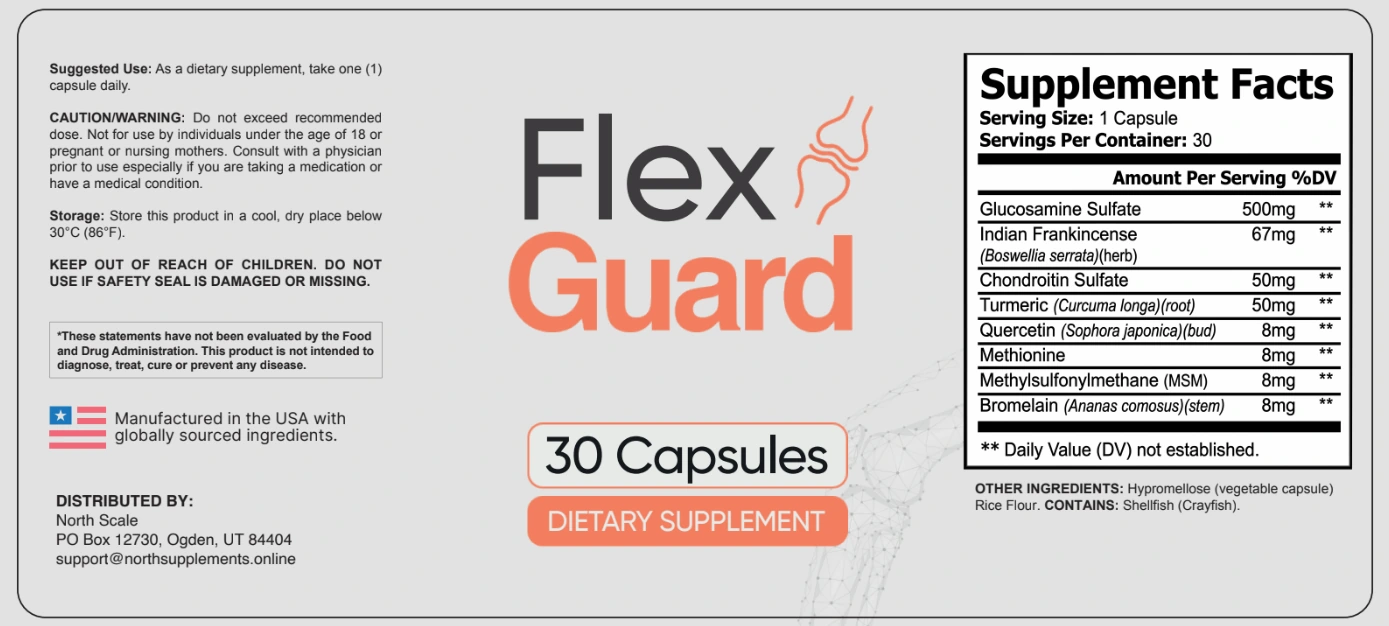
The label's own caution opens with "Do not exceed recommended dose." It then rules out anyone under 18 and anyone pregnant or nursing, and it says to consult a physician before use, especially with a medication or a medical condition. That is all the safety text printed on the bottle.
FlexGuard is a dietary supplement. It is not a drug, it is not FDA approved, and no supplement is. These statements have not been evaluated by the Food and Drug Administration.
Does FlexGuard contain shellfish?
Yes. The panel prints "Contains: Shellfish (Crayfish)". Glucosamine for supplements is made from crustacean shell, and this label names the species. That one line makes the product unsuitable for anyone with a shellfish allergy.
The research is more reassuring than the label sounds. A controlled challenge gave shrimp-derived glucosamine to shrimp-allergic adults and recorded no reactions, because the allergen is a muscle protein, not the shell. An allergy group reached the same view. Even so, the label declaration governs. A reaction is not worth risking to save a capsule, so this site treats the product as unsuitable if you have the allergy.
The same line answers the vegan question. The shell is hypromellose, which is plant-derived. The glucosamine inside is not. So FlexGuard is not vegan or vegetarian.
Can you take FlexGuard with warfarin or other medicines?
Glucosamine has been reported to raise INR in people taking warfarin. A case report with a review of the MedWatch database sets out the reports. It is not common, and it is not just theory either. If you take warfarin, raise the capsule with your prescriber before the first dose, not after the next blood test.
Bromelain and quercetin carry bleeding cautions in the literature, but those belong to doses in the hundreds of milligrams. In FlexGuard each is 8 mg. The cautions are therefore theoretical here. Still, if you take any blood thinner, mention the capsule anyway.
The supplement facts page prints all eight rows, the allergen line and the caution, and the guarantee runs 60 days from the date of purchase.
See today's price and guarantee
Disclosure: this desk earns from orders placed through the checkout on this site. BuyGoods, the retailer at the checkout, shows the current price.
Will FlexGuard affect blood sugar?
Glucosamine is an amino sugar, which led to a long worry about glucose control. A review of oral glucosamine and glucose metabolism found no clinically significant effect at standard doses, in people with or without diabetes. This capsule carries a third of a standard dose. If you take diabetes medicine, still tell your doctor about any new supplement.
What are the side effects of FlexGuard?
The label prints no specific adverse effect beyond its general caution. The seller does not publish an adverse-event record, so this page cannot give you a rate. What it can do is describe what is typical for this class of ingredient, and it marks that clearly as general, not as verified reports about this product.
| What may happen | How common (this ingredient class) | What usually helps |
|---|---|---|
| Mild stomach upset in week one | The commonest report | Take the capsule with food. Bromelain is a digestive enzyme. |
| An odd taste or aftertaste | Occasional, and more with sulfur products at gram doses | Swallow with a full glass of water. At 8 mg of MSM it is unlikely. |
| Nothing at all in the early weeks | By far the most common experience | Expected. The typical wait is 3 to 6 weeks. |
| Joint pain that gets worse | Rare, and not a supplement question | Stop and have it looked at. |
| Rash, swelling or trouble breathing | Rare, and urgent | Stop at once and seek medical attention. |
The middle column describes the ingredient class, not verified reports about this product.
What about turmeric, MSM and the smaller rows?
A page can be made scary by listing every cautionary note any ingredient ever drew. Most of those belong to large doses. Turmeric at gram doses is discussed in connection with gallstones and with how other drugs are absorbed. Here the row is 50 mg of root. MSM has a safety record at gram doses, and this row is 8 mg.
The amounts that make this a modest dose are the same amounts that make most theoretical risks irrelevant. Both facts are true. We will not write that it is completely safe for everyone, because the label excludes four groups, one interaction is documented, and one allergen is declared.
Who should not take FlexGuard?
- Anyone with a shellfish allergy.
- Anyone vegan or vegetarian.
- Anyone under 18.
- Anyone pregnant or nursing.
- Anyone taking warfarin, until the prescriber has said yes.
- Anyone whose joint pain is new, severe, on one side, hot, swollen or after an injury. That needs an exam first.
Stop taking it, and get medical help, for any rash, swelling or trouble breathing. Also stop and ask a doctor if stomach upset lasts beyond the first week or if joint pain gets worse.
What should you do if something feels wrong?
Stop taking the capsule and speak to a doctor or pharmacist. If the problem is a broken safety seal, a bottle that arrived short or a damaged parcel, call the order desk on +1 (877) 257-0710 the same day, with your order ID to hand. Photograph a damaged parcel before you open it.
How long is it safe to keep taking it? The label gives no maximum length of use, and the seller publishes no long-term safety record for the formula. That is a reason to mention it to your doctor if you plan to use it for months, and to review your own joint numbers at week eight.
- Contains: Shellfish (Crayfish). Not for a shellfish allergy, and not vegan or vegetarian.
- Not for anyone under 18, pregnant or nursing.
- Glucosamine has been reported to raise INR in people on warfarin.
- No clinically significant blood sugar effect was found at standard doses, and this capsule holds a third of one.
- The label prints no specific adverse effect and the seller publishes no adverse-event record.
- Do not exceed the one capsule a day on the label.
- The capsule has no FDA approval, which is true of every supplement.
Frequently asked questions
Is FlexGuard safe?
For a healthy adult outside the excluded groups the amounts are small, but no supplement is safe for everyone. The label excludes under 18s, pregnant or nursing women, and the panel declares shellfish.
What are the side effects of FlexGuard?
The label prints none beyond its general caution. The commonest report in this ingredient class is mild stomach upset in the first week, which taking it with food often helps.
Is FlexGuard safe with a shellfish allergy?
The panel declares crayfish, so treat it as unsuitable. Research on shrimp-derived glucosamine is reassuring, but the label declaration still governs.
Can I take FlexGuard with warfarin?
Ask your prescriber first. Glucosamine has been reported to raise INR in people taking warfarin.
Does FlexGuard raise blood sugar?
A review found no clinically significant effect at standard doses in people with or without diabetes, and this capsule holds a third of a standard dose.
Should I see a doctor before taking FlexGuard?
Yes if you take any medicine, have a medical condition, or have joint pain that is new, severe, on one side, hot, swollen or followed an injury.
Our view
FlexGuard is easy to read on safety. There is one allergen, one named drug interaction, and a short list of groups to avoid. The seller states each plainly and does not claim the product is free of risk. We think that is the right tone.
Our advice is simple. If any line in this page describes you, talk to your doctor or pharmacist before the first capsule. If none does, stay with one capsule a day, and stop if anything odd appears.
If the shellfish and warfarin points do not apply to you, the order page shows the current price.
See today's price and guarantee
Disclosure: this desk earns from orders placed through the checkout on this site. BuyGoods, the retailer at the checkout, shows the current price.
FlexGuard is a dietary supplement. It is not a drug, it is not FDA approved, and no dietary supplement is. These statements have not been evaluated by the Food and Drug Administration. This product is not intended to diagnose, treat, cure or prevent any disease. Ask a doctor about your own health, medicines and joints.
Sources named on this site
- A case report and MedWatch review on glucosamine and warfarin (PubMed)
- A review of glucosamine and glucose metabolism (PubMed)
- A controlled challenge in shrimp-allergic adults (PubMed)
- The German federal safety review of quercetin (PubMed)
- A review of the bromelain trials (PubMed)
- NCCIH on turmeric
- NCCIH on choosing a supplement
- A 2017 review of MSM (PubMed)
Last updated