FlexGuard Official Website › Blog › How Do You Take FlexGuard?
How Do You Take FlexGuard? Dosage, Timing and Daily Routine
Take one capsule a day, as the label says: "As a dietary supplement, take one (1) capsule daily." The label sets no hour and no food rule. Do not take more than one. A bottle holds 30 capsules, so it lasts a month. Ask a doctor first if you take medicine or have a condition.
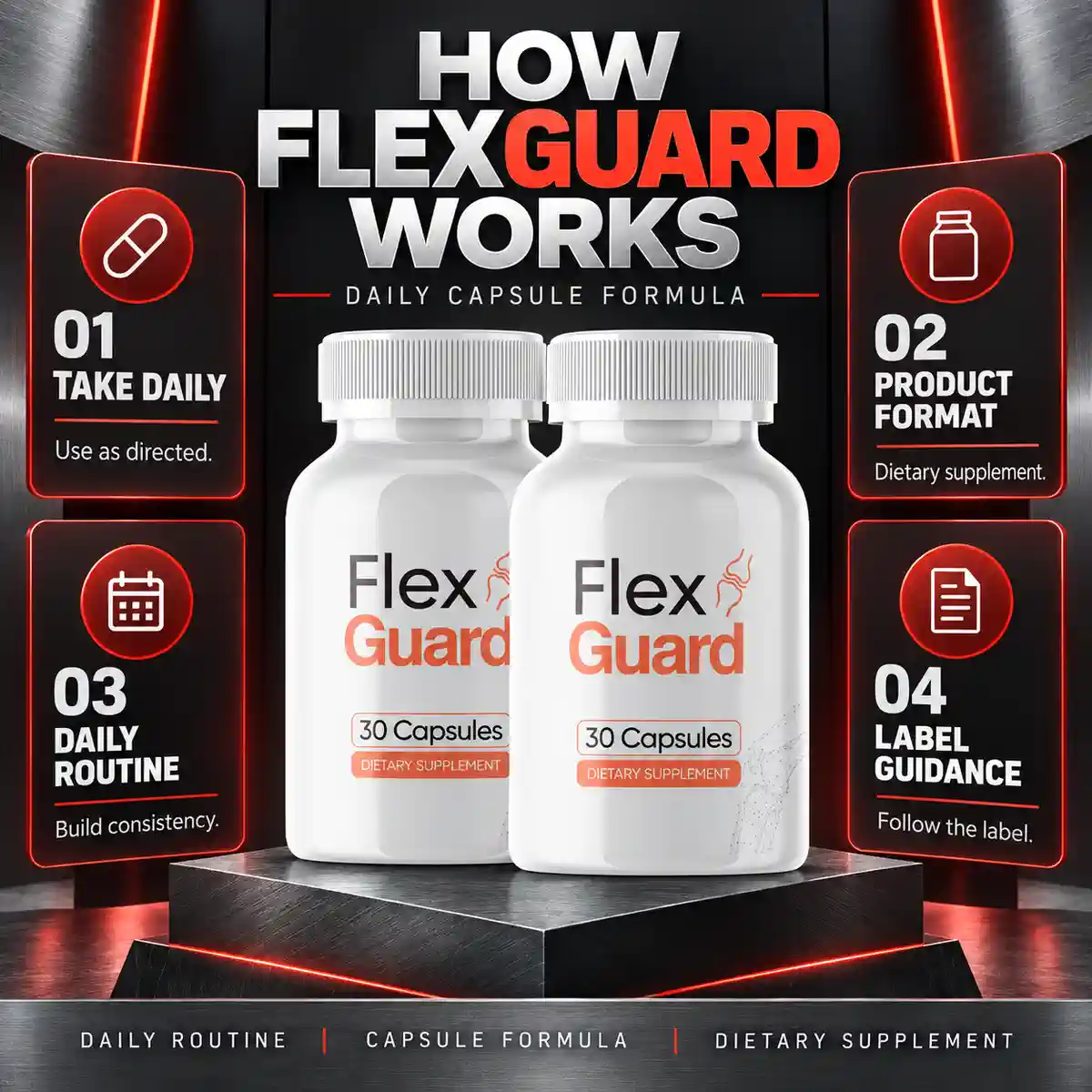
Taking this product takes about three seconds. What helps is the routine around it. This page covers the dose, the timing questions people ask, what to do when life gets in the way, and how to keep the bottle in good shape.
How do you take FlexGuard, and how many a day?
One capsule, once a day. The label wording is: "As a dietary supplement, take one (1) capsule daily." That is the entire instruction. There is no loading phase, no cycling on and off, and no second dose to remember.
The label also warns: "Do not exceed recommended dose." So the answer to how many FlexGuard a day is one. Not two, even if you are impatient.
| Question | What the label and seller say |
|---|---|
| Capsules per day | 1 |
| Capsules per bottle | 30 |
| One bottle lasts | 30 days |
| Time of day | Not specified |
| With food | Not specified |
| Maximum | Do not exceed the recommended dose |
| Age | Not for anyone under 18; no upper limit is printed |
| Pregnant or nursing | Not for use |
Dose text is quoted from the label. Where the label is silent, this page says so.
When to take FlexGuard: morning, night, or with a meal?
The label sets no hour, and nothing on the panel depends on the time of day. So the best time is whichever you will not forget. Pick a fixed slot that is tied to something you already do without thinking, such as the kettle or the toothbrush.
With food or without? The label does not say. One ingredient, bromelain, is a protein-digesting enzyme, so some people find a capsule sits better with a meal. It is only 8 mg here. If your stomach complains in the first week, try it with food.
No ingredient on this panel needs fat to be absorbed, which is the usual reason a supplement asks for a meal. So a snack is not required.
Can I take FlexGuard daily, and for how long?
Daily is the way it is meant to be taken. The label does not give a maximum length of use. It also does not say how long to continue. The seller suggests a clear test period: judge it at week four and decide before day 60, counted from the date of purchase.
There is no course to complete. If you decide it is not for you, stop. The seller notes that nothing on this panel produces a rebound, and no tapering is needed. If you are unsure, ask your doctor or pharmacist.
What if you miss a day?
Take the next capsule at the usual time. Do not double up. The label says not to exceed the recommended dose, and nothing here works faster in twos.
Can you take two capsules to get closer to the trial dose?
No. It is a tempting thought, since glucosamine is 500 mg here and the big trials used 1,500 mg. But two capsules would still be 1,000 mg of glucosamine, short of the trial amount. It would also double seven other rows that nobody has studied at that level. The label says one, and this site agrees.
The window counts from the date of purchase, so write that date on the bottle when it arrives.
See today's price and guarantee
Disclosure: this desk earns from orders placed through the checkout on this site. BuyGoods, the retailer at the checkout, shows the current price.
How do you set up a fair 60-day routine?
- Choose a slot you will keep every day.
- Write the date of purchase on the bottle in pen. It is on the checkout email.
- Before the first capsule, record two numbers you can count. For example, minutes until the first stairs of the day feel normal, and how far you walk before a knee speaks up.
- Change nothing else for four weeks. Starting a capsule, new shoes and a walking habit in one week makes the result unreadable.
- Take the same two measurements at week four and again at week eight, then decide inside the window.
If you want to add exercise, add it on its own and on purpose. The Cochrane review of exercise for knee osteoarthritis pooled fifty-four trials and found land-based exercise improved pain and physical function. That evidence is larger than anything on this panel.
Can you take FlexGuard with other medicines or supplements?
Ask your doctor or pharmacist, as the label says. One interaction deserves a name: glucosamine has been reported to raise INR in people taking warfarin, so raise it before the first dose.
Nothing on this panel is a vitamin or mineral, so a multivitamin does not overlap with it. The thing to check is another joint product. Two bottles can both say glucosamine, and adding them gets you to an amount you never chose. The same goes for anything that contains MSM.
How should you store the bottle?
The label says: "Store this product in a cool, dry place below 30°C (86°F)." A bathroom cabinet is the worst place, as it is warm and damp after every shower. A kitchen cupboard away from the hob is better. A bedside drawer is better still, because it is where the routine lives.
Also check the seal. The label says: "Keep out of reach of children. Do not use if safety seal is damaged or missing." The lot code and best-before date are printed on the base. If you bought six bottles, keep the unopened ones cool and dark, and check the date on each before you start it.
How many bottles do you need for a full trial?
| Pack | Capsules | Days at one a day |
|---|---|---|
| 2 bottles | 60 | 60 |
| 3 bottles | 90 | 90 |
| 6 bottles | 180 | 180 |
Each bottle holds 30 capsules. The 60-day clock starts on the purchase date.
Two bottles end on the same day the refund window does, so there is no spare capsule for a delay in the post. Three bottles leave a month of margin. Six are a commitment. If you cannot be sure you will keep up the habit every day, the smaller pack is the more honest test.
- One capsule a day. Do not exceed the recommended dose.
- 30 capsules per bottle, so a bottle lasts a month.
- No time of day and no food rule is printed on the label.
- If you miss a day, take the next one as usual. Do not double up.
- Store below 30°C (86°F) in a cool, dry place.
- Keep it away from children and teens under 18, and from anyone who is pregnant or nursing.
- Judge it at week four and decide before day 60 from the date of purchase.
Frequently asked questions
How do I take FlexGuard?
The label sets one capsule a day, so that is the dose to use. It sets no time of day and no food rule, and it warns not to exceed the recommended dose.
How many FlexGuard capsules should I take a day?
One. Two would still leave glucosamine below the trial amount, and it would double seven other ingredients that nobody has studied at that level.
When is the best time to take FlexGuard?
Whenever you will remember. No ingredient on the panel is affected by time of day. Taking it with food may help if your stomach is sensitive.
Can I take FlexGuard every day?
Yes, daily is the intended use. The label gives no maximum length of use, so ask your doctor if you plan to take it for a long time.
What if I miss a dose of FlexGuard?
Take the next capsule at the usual time and do not double up.
How should I store FlexGuard?
Keep it in a cool, dry place below 30°C (86°F), away from damp rooms such as the bathroom, and check that the safety seal is intact.
Our view
A once-a-day capsule is the kindest thing about this product. There is no schedule to manage. The challenge is not the dose, it is the patience, and the habit of measuring something so that your verdict is not just a feeling.
We would write down two numbers, keep to one capsule a day, and decide at week eight. If you take any medicine, have a medical condition, or have a shellfish allergy, talk to your doctor before the first capsule.
One capsule a day is the label dose, and the guarantee clock starts on the day you buy.
See today's price and guarantee
Disclosure: this desk earns from orders placed through the checkout on this site. BuyGoods, the retailer at the checkout, shows the current price.
FlexGuard is a dietary supplement. It is not a drug, it is not FDA approved, and no dietary supplement is. These statements have not been evaluated by the Food and Drug Administration. This product is not intended to diagnose, treat, cure or prevent any disease. Ask a doctor about your own health, medicines and joints.
Sources named on this site
Last updated