FlexGuard Official Website › Blog › Does FlexGuard Work? What the Evidence Says
Does FlexGuard Work? What the Evidence Says
Nobody can say yet. No trial has tested this FlexGuard formula at these amounts. The research that exists covers single ingredients, mostly at larger doses than one capsule holds. Boswellia is the one row near its studied amount. Treat the 60-day guarantee as your own test.
Search results for does FlexGuard work are full of confident answers in both directions. Most of them sound sure without having anything to be sure about. This page tries a slower route. It lists what has been tested, what has not, and what you can measure at home.
Does FlexGuard really work, or is that the wrong question?
It is a fair question, but it hides a trap. Work for what, and measured how? The seller only claims support for joint comfort, mobility and everyday movement, and for the body through everyday joint stress. Those words are soft on purpose. They cannot be proved or disproved by one number.
So a better question is this one. Do the amounts in one capsule match the amounts that research tested? That question has an answer, because the label prints every amount. The answer is mixed, and the next sections show where.
Has anyone tested the FlexGuard formula itself?
No. The seller's own pages say it plainly: no trial of this formula at these amounts has been run. There is no study with a FlexGuard arm and a placebo arm. Any page that quotes a FlexGuard study is quoting something this site cannot find.
What exists is a pile of research on the single ingredients. That research is real, and it is worth reading. But it was done on other products, at other doses, and in people who often had a diagnosed knee condition. It tells you about the ingredients. It does not tell you about this capsule.
Does the FlexGuard supplement work if you read it ingredient by ingredient?
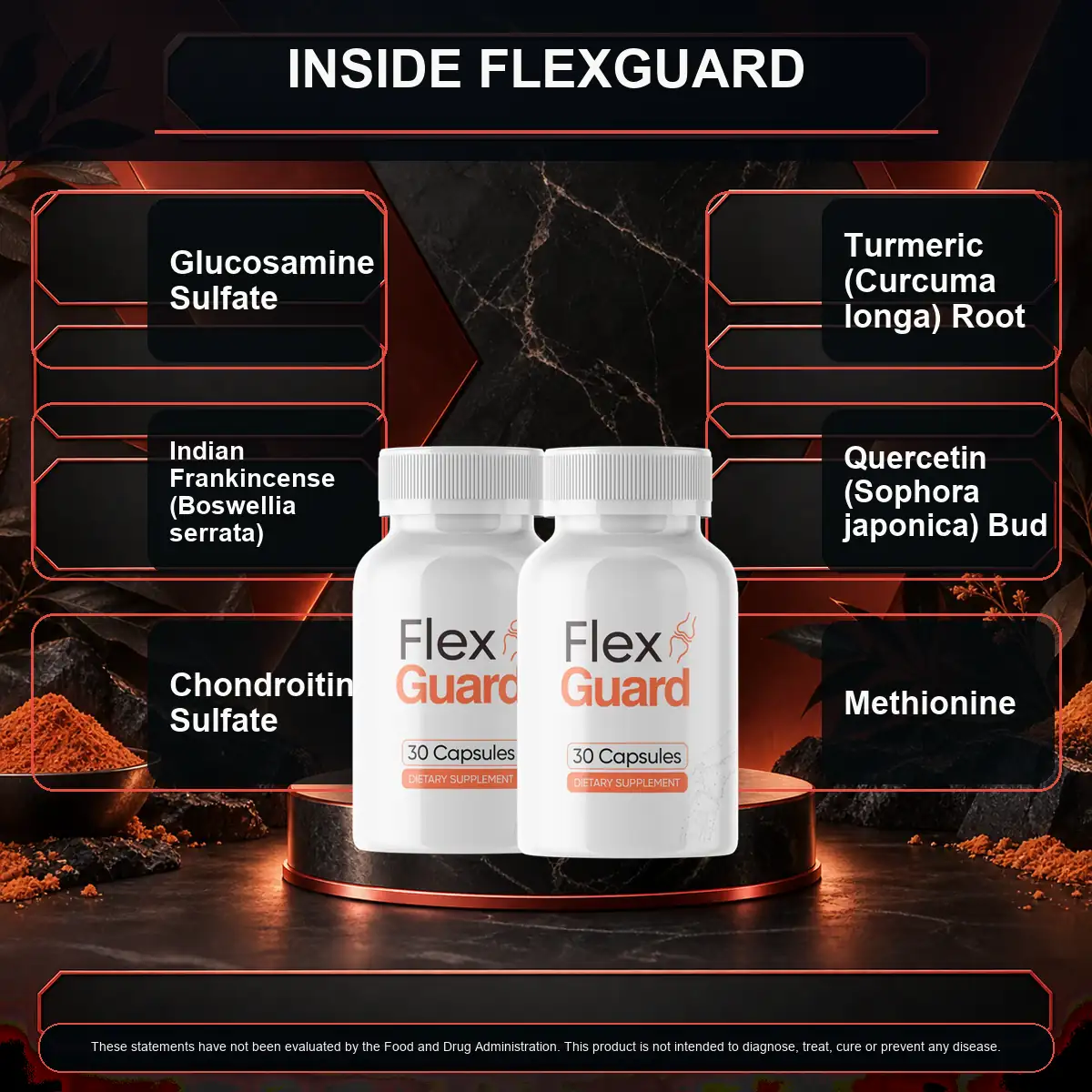
Here is the label next to the research, row by row. The right-hand column comes from the sources the seller names.
| Ingredient | In one capsule | Amount in the published trials |
|---|---|---|
| Glucosamine sulfate | 500 mg | 1,500 mg a day in GAIT and in the three-year sulfate trial |
| Boswellia serrata (herb) | 67 mg | 100 to 250 mg a day of a 30 per cent AKBA extract; 1,000 mg of gum resin in the 2003 crossover |
| Chondroitin sulfate | 50 mg | 800 to 1,200 mg a day across the 43 trials Cochrane pooled |
| Turmeric (root) | 50 mg | About 1,000 mg a day of a standardised extract |
| Quercetin (bud) | 8 mg | 250 mg a day upward in the supplement literature |
| Methionine | 8 mg | No joint trial of methionine alone |
| Methylsulfonylmethane (MSM) | 8 mg | 3.4 g a day in the 2011 trial, 6 g in the 2006 pilot |
| Bromelain (stem) | 8 mg | Hundreds of milligrams a day in the trials collected in the 2004 review |
Source: the seller's own dose comparison, which cites each trial. A different amount is not a failed test. It is an untested one.
Read the table from the top. Glucosamine is the largest row, and it sits at one third of the trial amount. Chondroitin is about a sixteenth. Four rows sit at 8 mg, and the MSM trials were counted in grams. Only boswellia lands in the same range as its research.
Why do the big glucosamine trials disagree?
Glucosamine has the largest pile of trials in this field, and the pile does not point one way. The NIH-funded GAIT trial put 1,583 people on glucosamine, chondroitin, both, an anti-inflammatory drug or a placebo. Neither supplement separated significantly from placebo for the group as a whole.
A separate three-year trial of glucosamine sulfate at 1,500 mg a day reported changes in symptoms and in joint space width. The Cochrane review of glucosamine pooled twenty studies in 2,570 people. It found that the result depended on which preparation was tested.
Two clinical guidelines then looked at the whole pile. The 2019 American College of Rheumatology guideline recommends against glucosamine for knee, hip and hand osteoarthritis. The 2019 OARSI guidelines decline to endorse it for symptom relief. Both conclusions are about a diagnosed condition at the full 1,500 mg. Neither speaks to a 500 mg comfort claim in someone with no diagnosis, because nobody has run that trial.
The guarantee runs 60 days from the date of purchase, which is long enough to take two simple measurements before and after.
See today's price and guarantee
Disclosure: this desk earns from orders placed through the checkout on this site. BuyGoods, the retailer at the checkout, shows the current price.
Is boswellia the row that gives FlexGuard its best case?
Of the eight, boswellia has the most direct joint research that sits near the label amount. The 2003 crossover trial used 1,000 mg of gum resin and reported less knee pain and greater walking distance. The 5-Loxin trial used a 30 per cent AKBA extract at 100 mg and 250 mg a day for ninety days, and the extract's maker paid for it.
At 67 mg, FlexGuard is in the same order of magnitude as 100 mg. But the label prints no extract ratio and no AKBA percentage. So the match is indicative, not exact. The seller says so itself, and it is worth keeping in mind.
What about turmeric, quercetin, MSM and bromelain?
These are the rows that do most of the talking on a front label and the least on the panel. Turmeric is listed as root, not as a standardised extract. The joint trials used curcuminoids at about 1,000 mg a day, and root powder carries only a small share of curcuminoid.
Quercetin is poorly absorbed, which is one reason its studies use hundreds of milligrams. Bromelain trials were small. MSM is the clearest case: the label unit is milligrams and the research unit is grams. Methionine is an amino acid your food already supplies, and it has no joint trial of its own.
How can you test whether FlexGuard works for you?
Joint comfort moves up and down on its own with weather, shoes, sleep and activity. That makes it easy to credit or blame the wrong thing. A short routine keeps you honest.
- Write down today's date of purchase. The 60-day window counts from it.
- Before the first capsule, record two numbers. For example, minutes of morning stiffness and how far you walk before you notice a joint.
- Take one capsule a day, as the label says. Do not take more.
- Change nothing else for the first four weeks. No new shoes, no new routine.
- At week four, take the same two measurements as a checkpoint. At week eight, take them again and decide before day 60.
The distributor puts the typical wait at 3 to 6 weeks. That is its own summary figure, not a trial result, but it fits the slow pace of this whole category.
What has better evidence than any capsule?
Exercise. The Cochrane review of exercise for knee osteoarthritis pooled fifty-four trials and found that land-based exercise improved both pain and physical function. No ingredient on this panel has a result of that size behind it. A capsule, if you choose one, sits beside movement, not instead of it.
Joint pain that is new, severe, on one side only, hot, swollen, or that followed an injury needs an examination, not a supplement. If you take warfarin or any other medicine, or have a medical condition, speak to your doctor before you start.
- No trial of the FlexGuard formula at these amounts has been run.
- Glucosamine, 500 mg, is a third of the 1,500 mg used in the major trials.
- Chondroitin, 50 mg, is about a sixteenth of the pooled trial amount.
- Boswellia, 67 mg, is the one row near its studied range.
- The label prints no extract ratio for boswellia or turmeric.
- Two 2019 guidelines do not endorse glucosamine for osteoarthritis at the full dose.
- The guarantee runs 60 days from the date of purchase.
- FlexGuard is not a drug and not FDA approved.
Frequently asked questions
Does FlexGuard work?
That is not known. No trial has tested this formula at these amounts. Research on its single ingredients exists, mostly at larger doses than one capsule holds.
Does FlexGuard really work for joint comfort?
The seller claims support for joint comfort, not a treatment. Boswellia at 67 mg is near its studied range. Most other rows sit well below the amounts that trials tested.
Why is glucosamine at 500 mg a problem?
It is not a problem so much as a gap. The major trials used 1,500 mg a day, so 500 mg is a third of the tested amount and nobody has tested it alone.
Do the guidelines say glucosamine works?
The 2019 American College of Rheumatology guideline recommends against it for knee, hip and hand osteoarthritis, and the 2019 OARSI guidelines decline to endorse it for symptom relief.
How long should I try FlexGuard before judging it?
The distributor puts the typical wait at 3 to 6 weeks. Measure at week four, decide at week eight, and finish before day 60 from the date of purchase.
Is FlexGuard any good then?
It is a simple, open label with modest amounts. Whether it suits you depends on what you expect. It does not treat arthritis, and a doctor should look at new or severe joint pain.
Our view
The honest answer to whether FlexGuard works is that the question cannot be settled from outside. The formula is untested as a whole, and six of its eight rows are below the amounts their own research used. That is not a scandal. It is how a one-capsule, eight-ingredient product usually looks.
What the label does well is tell you every amount, so you can see the gap for yourself. If you like a once-a-day routine and you accept that, a 60-day trial with two simple measurements is a fair way to find out. If you want glucosamine at the studied amount, read the panel first, and talk to your doctor either way.
The 60-day window is long enough for a simple before-and-after note, and the choice stays with you.
See today's price and guarantee
Disclosure: this desk earns from orders placed through the checkout on this site. BuyGoods, the retailer at the checkout, shows the current price.
FlexGuard is a dietary supplement. It is not a drug, it is not FDA approved, and no dietary supplement is. These statements have not been evaluated by the Food and Drug Administration. This product is not intended to diagnose, treat, cure or prevent any disease. Ask a doctor about your own health, medicines and joints.
Sources named on this site
- The GAIT trial (PubMed)
- The Cochrane review of glucosamine (PubMed)
- The three-year Lancet trial of glucosamine sulfate (PubMed)
- The 2003 Boswellia crossover trial (PubMed)
- The 5-Loxin trial (PubMed)
- A 2016 meta-analysis of the turmeric trials (PubMed)
- The 2019 American College of Rheumatology guideline (PubMed)
- The 2019 OARSI guidelines (PubMed)
- The Cochrane review of exercise (PubMed)
- NCCIH on glucosamine and chondroitin for osteoarthritis
Last updated