FlexGuard Official Website › Blog › Do Joint Supplements Work?
Do Joint Supplements Work, and How Do You Choose One?
The evidence is mixed. Glucosamine and chondroitin have the most trials, but better studies tend to find less, and two 2019 guidelines do not endorse glucosamine for osteoarthritis. A label with every amount printed lets you compare it with the trial doses. Exercise has stronger evidence than any capsule.
Joint supplements fill a whole aisle, and the labels shout. Are joint supplements any good? Are they worth it, safe, or a scam? This page answers in general terms, using the research the FlexGuard site cites. It does not name any other brand. It ends with a method you can use on any bottle.
What are joint supplements, and how do they work?
A joint supplement is a capsule, tablet, powder or gummy sold to support joint comfort and movement. They are dietary supplements, not drugs. Nearly all of them draw from four families of ingredient. Each family has its own idea of how it helps.
| Family | Examples | The idea behind it |
|---|---|---|
| Cartilage components | Glucosamine, chondroitin sulfate | Supply materials that cartilage is built from |
| Plant extracts | Boswellia, turmeric, bromelain, quercetin | Act on inflammatory signalling, not on structure |
| Sulfur compounds | MSM, methionine | Supply sulfur; MSM has its own trials, always in grams |
| Collagen | Type II or hydrolysed collagen | Different products with the same word on the front |
Based on the categories in the seller's joint supplement guide.
These are ideas, not guarantees. How much of each idea reaches a joint depends on the dose, the preparation and the person.
Do joint supplements work, or do any joint supplements really work?
The glucosamine and chondroitin evidence is the largest and the most argued over. The NIH-funded GAIT trial gave 1,583 people glucosamine at 1,500 mg a day, chondroitin at 1,200 mg, both, an anti-inflammatory or placebo. Neither supplement separated significantly from placebo overall. The Cochrane review of glucosamine found that results depended on which preparation was tested. The Cochrane review of chondroitin found a small pain benefit at low quality of evidence across 43 trials.
Two guidelines then weighed the whole pile. For knee, hip and hand osteoarthritis, the 2019 American College of Rheumatology guideline advises against glucosamine. The 2019 OARSI guidelines also stop short of backing it for symptom relief. NCCIH sums it up fairly: some studies find benefit, the better-conducted ones tend to find less, and results vary by preparation.
For plant extracts, boswellia has the most direct joint research. NCCIH calls that field small and uneven. Turmeric trials mostly used a standardised extract, not root powder.
So are cartilage supplements and the rest worth it? The fair reading is that some people report benefit, the data are inconsistent, and nobody can promise you a result. No supplement rebuilds cartilage.
Are joint supplements safe?
Mostly the safety questions are specific. Glucosamine is usually made from crustacean shell, so a label often declares shellfish and the product is then not vegan. Reports link glucosamine to a higher INR in people who take warfarin. Many other cautions belong to doses far above what a capsule holds.
The label should tell you who it is not for. Age limits, pregnancy and the medicine line are on almost every bottle. If you take any medicine or have a condition, talk to a doctor or pharmacist first. NCCIH also advises telling the clinician you already see about everything you take.
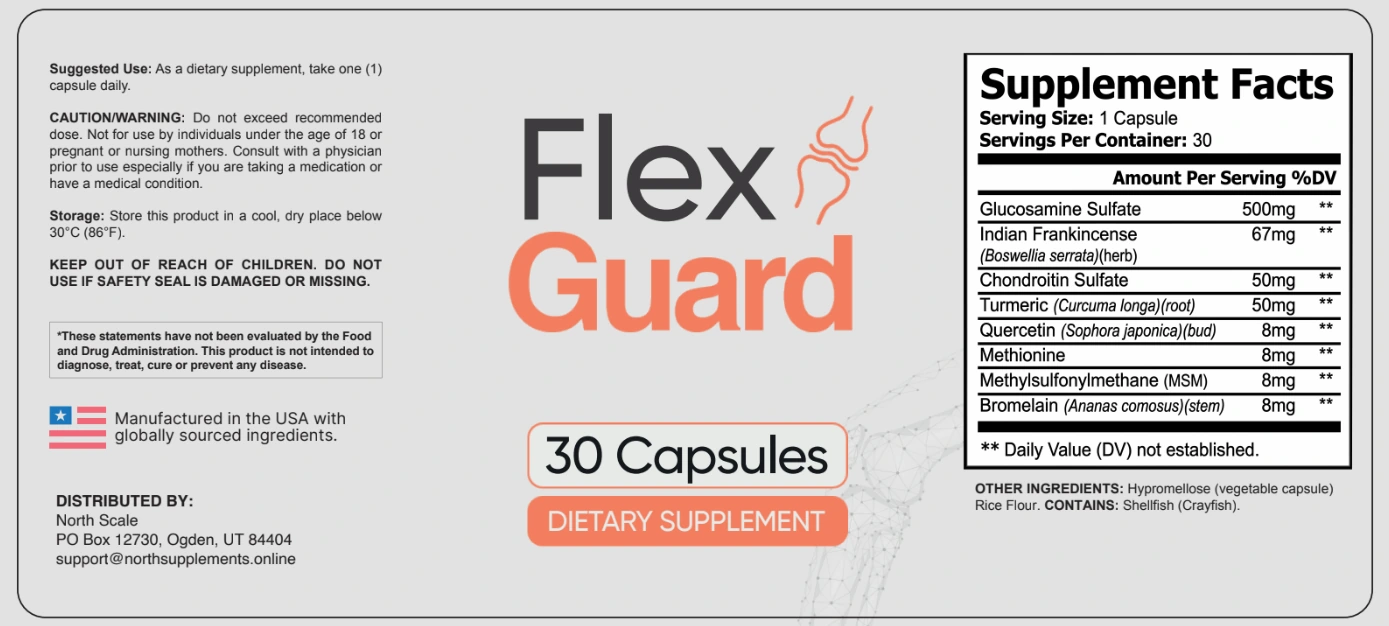
FlexGuard prints all eight amounts. You can run the same checks on it, with 60 days from the date of purchase to decide.
See today's price and guarantee
Disclosure: this desk earns from orders placed through the checkout on this site. BuyGoods, the retailer at the checkout, shows the current price.
How do you choose a joint supplement, whatever the brand?
There is no honest way to name a single best joint supplement from outside your own life. There is, though, a quick way to read any panel. These eight checks are in the order that discards the most bottles fastest.
- Serving size first. Every number is per serving, and a serving is often two or three capsules. Multiply before you compare.
- Look for a blend. A row reading proprietary blend with one total hides the individual amounts.
- Find the largest row. On most joint capsules it is glucosamine. The trials used 1,500 mg a day.
- Check the plant rows for a ratio. An extract with no ratio cannot be matched to any trial.
- Check the units. A single-figure milligram amount of something studied in grams is decoration.
- Read the allergen line. Shellfish on a glucosamine product is expected, and it also settles the vegan question.
- Read the caution. Age, pregnancy and medicine lines tell you who should skip it.
- Then read the front. The panel is a legal document, and the front is marketing.
Also ask about the refund window. A 60-day window is about right for a field whose trials ran eight to twelve weeks. A 30-day window ends before most people can form a view. Check whether the window counts from purchase or from dispatch.
How do you take joint supplements, and when?
Follow the label, since serving sizes differ. A once-daily capsule is easier to keep up than a four-capsule routine, and the biggest reason a two-month trial fails is gaps. Pick a slot you will keep, and take it with food if your stomach is sensitive. Write down two simple numbers before you start, and again at week eight.
Do not double up to chase a studied dose. And when the dose is described in the sources as grams or hundreds of milligrams, remember that a tiny amount of the same name is not the same thing.
What helps joints more than any capsule?
Exercise. In knee osteoarthritis, a Cochrane review of exercise gathered fifty-four trials, and land-based exercise helped both pain and physical function. No ingredient in this whole category has a result of that size and steadiness behind it. Body weight matters too, since the load through a knee is a multiple of it. The NIAMS and MedlinePlus pages on osteoarthritis put both near the top.
None of this makes a supplement pointless. It makes it a supplement: something added to the things that work, not bought in place of them.
Joint pain that is new, severe, on one side only, hot, swollen, or that followed an injury needs examining, not supplementing. One appointment can settle more than a year of capsules.
- Four ingredient families cover nearly every joint supplement.
- Glucosamine and chondroitin have the most trials, and results are mixed.
- Even at the full dose, glucosamine is not endorsed for osteoarthritis by two 2019 guidelines.
- Check serving size, blends, units and the allergen line first.
- Trials ran about eight to twelve weeks, so give any product a fair run.
- Exercise has stronger evidence than any capsule.
- No supplement is FDA approved or meant to treat a disease.
Frequently asked questions
Do joint supplements work?
The evidence is mixed. Some studies find benefit, the better-conducted ones tend to find less, and results vary by preparation. No supplement can promise a result.
Are joint supplements safe?
Often, but not for everyone. Glucosamine is usually made from shellfish, and it has been reported to raise INR in people on warfarin. Ask a doctor if you take medicine.
Are joint supplements worth it?
That depends on your goals and the label. Compare each amount with the trial doses, give it eight to twelve weeks, and measure something you can count.
What should I look for in the best joint supplement?
Look for an amount printed on every row, no hidden blend, plant extracts with a stated ratio, a clear allergen line and a refund window long enough to test it.
How do you take joint supplements?
Follow the label for serving size, pick a time you will keep, and take it with food if your stomach is sensitive. Do not exceed the stated dose.
What works better than a joint supplement?
Exercise has the stronger evidence. The Cochrane review pooled fifty-four trials and found land-based exercise improved pain and function in knee osteoarthritis.
Our view
Joint supplements are a fair thing to try if you go in with clear eyes. The evidence is uneven, the doses on labels often sit below the trial amounts, and the best-supported step is exercise. A good label at least lets you see all of that.
Use the eight checks, measure two numbers, and keep an honest eye on the refund date. Ask your doctor before you start if you take medicine or have joint pain that worries you.
FlexGuard prints every amount, which makes it simple to compare with any other label you hold.
See today's price and guarantee
Disclosure: this desk earns from orders placed through the checkout on this site. BuyGoods, the retailer at the checkout, shows the current price.
FlexGuard is a dietary supplement. It is not a drug, it is not FDA approved, and no dietary supplement is. These statements have not been evaluated by the Food and Drug Administration. This product is not intended to diagnose, treat, cure or prevent any disease. Ask a doctor about your own health, medicines and joints.
Sources named on this site
- The GAIT trial (PubMed)
- The Cochrane review of glucosamine (PubMed)
- The Cochrane review of chondroitin (PubMed)
- The 2019 American College of Rheumatology guideline (PubMed)
- The 2019 OARSI guidelines (PubMed)
- The Cochrane review of exercise (PubMed)
- NCCIH on glucosamine and chondroitin for osteoarthritis
- NCCIH on choosing a supplement
- The Arthritis Foundation supplement guide
- MedlinePlus on osteoarthritis
- NIAMS on osteoarthritis
- 21 CFR 101.36, nutrition labeling of dietary supplements
Last updated